Clinique TAGMED Montréal / Mont-Royal · Mini-pilier — Protrusion et pincement
Sciatica, protrusion and disc-space narrowing: understanding degenerative changes
A starting point for the specialized guides on sciatica in Montreal
Les termes protrusion, bombement, pincement et dégénérescence décrivent des changements différents du disque lombaire. Ils peuvent être associés à une irritation radiculaire, mais ils sont aussi fréquents chez des personnes sans douleur; la concordance clinique reste donc essentielle.
- Part of the guide series on Sciatica treatment in Montreal.
- This page brings together the specialized guides already published on this topic.
- The content distinguishes general information, clinical assessment and situations requiring medical referral.

Overview
Understanding this group of guides
Ce mini-pilier rassemble les guides portant sur les changements discaux et articulaires pouvant réduire l’espace disponible ou modifier les charges autour des racines nerveuses.
Disque
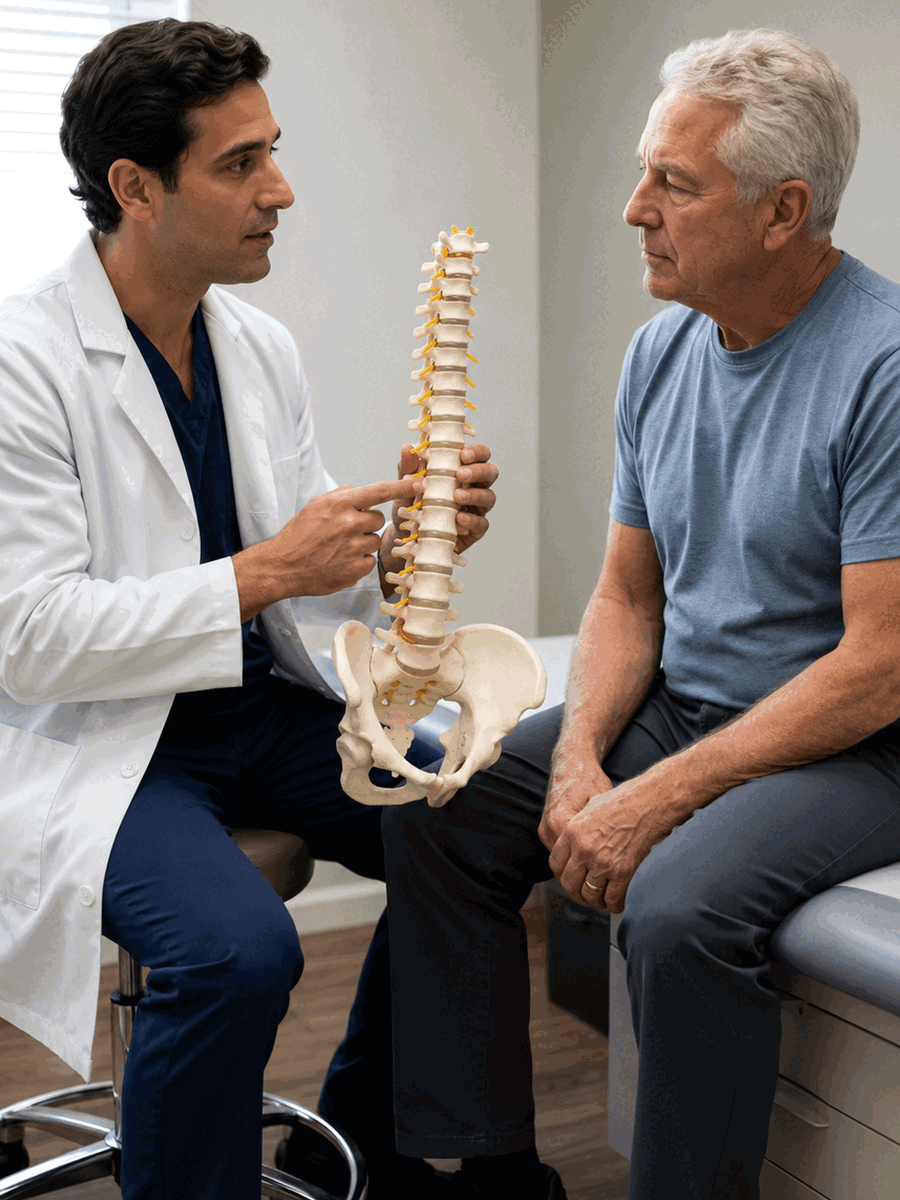
Une protrusion décrit une modification de contour du disque, tandis qu’un pincement renvoie surtout à une diminution de hauteur discale.
Espace foraminal
La diminution de hauteur et l’arthrose peuvent contribuer à réduire l’espace de sortie d’une racine nerveuse.
Concordance
Le diagnostic ne repose pas sur un mot du rapport d’IRM, mais sur la concordance entre symptômes, examen et imagerie pertinente.
Explore these guides
Specialized guides to explore
These pages explore the main questions on this topic and link to the main guide on sciatica in Montreal.
Disc protrusion and sciatica
Explore this topic in the Montreal sciatica guide series.
Disc space narrowing and sciatica
Explore this topic in the Montreal sciatica guide series.
Arthrose lombaire et sciatique
Explore this topic in the Montreal sciatica guide series.
Syndrome facettaire et sciatique
Explore this topic in the Montreal sciatica guide series.
Spondylolisthesis and sciatica
Explore this topic in the Montreal sciatica guide series.
Causes of sciatica
Explore this topic in the Montreal sciatica guide series.
Clinical interpretation
Putting the information in context
Les termes protrusion, bombement, pincement et dégénérescence décrivent des changements différents du disque lombaire. Ils peuvent être associés à une irritation radiculaire, mais ils sont aussi fréquents chez des personnes sans douleur; la concordance clinique reste donc essentielle. Une conclusion clinique solide repose sur la concordance entre les symptômes, l’examen, la fonction et les examens complémentaires lorsqu’ils sont pertinents.

An important point
An imaging abnormality, a clinical test or an area of pain should not be interpreted in isolation. Changes in strength, sensation and function remain key considerations.
Assessment
Planning the next steps
A consultation can clarify the level of priority, identify signs requiring medical referral and determine whether conservative care, further investigation or another option should be discussed.

Describe
Distribution, duration, intensity, triggers and recovery.
Examine
Strength, sensation, reflexes, walking and relevant tests.
Correlate
Compare clinical findings with available investigations when relevant.
Decide
Choose the next steps and criteria for reassessment.
Support
Match care options to the likely cause and functional needs
Care may combine information, continued tolerated activities, rehabilitation and other conservative approaches. Depending on severity, duration and neurological signs, further investigation or medical referral may be appropriate. Each intervention should be considered in the context of the patient and their goals.
Self-management and activity
Information, tolerated movement, load adjustment and gradual progression.
Conservative approaches
Exercise, rehabilitation and interventions suited to the clinical profile.
Medical referral
Imaging, injections or specialist advice according to indications and progression.
When should you seek prompt or emergency care?
- New, significant or rapidly progressive weakness.
- Recent foot drop or a leg that gives way more often.
- New bladder or bowel problems.
- Numbness in the saddle area or perineum.
- Significant symptoms on both sides, major trauma, fever or a decline in general health.
These signs should not wait for a routine appointment. Urgent medical assessment may be necessary.
Follow-up
Measuring progress through function
Follow-up compares important activities: walking, sitting, sleeping, working, sports, daily tasks and recovery after exertion. These measures help determine whether the plan should be continued or adjusted.
Function
Compare the activities that matter to the person.
Neurology
Monitor strength, sensation and any new deterioration.
Main guide
Would you like an assessment of your sciatica symptoms?
A consultation can help clarify the likely cause, signs to watch for and relevant options based on function and progression.
Frequently Asked Questions
FAQ — Sciatique, protrusion et pincement discal : comprendre les changements dégénératifs
Why is this topic important for sciatica?
Ce mini-pilier rassemble les guides portant sur les changements discaux et articulaires pouvant réduire l’espace disponible ou modifier les charges autour des racines nerveuses.
Is one symptom enough to identify the cause?
No. Symptom distribution, strength, sensation, function and progression need to be interpreted together.
Is an MRI always necessary?
No. Imaging is most useful when it may change management or when the clinical context justifies it.
Should all activities be stopped?
Not as a general rule. Activities are adapted to tolerance and neurological signs, with gradual progression when possible.
When should you seek medical help quickly?
New or progressive weakness, foot drop or a significant deterioration in walking warrants prompt assessment.
Can pain alone be used to judge progress?
No. Walking, sleep, work and other important activities are useful measures of progress.
Which signs require urgent assessment?
New bladder or bowel problems, saddle anaesthesia or severe, rapidly progressive weakness require urgent medical assessment.
Medical references
References and guidelines
These references provide a general framework for assessing low back pain with sciatica, radiculopathy and the use of imaging. They do not replace individualized clinical decisions.
- NICE NG59 — Low back pain and sciatica: assessment and management
- American College of Radiology — Appropriateness Criteria: Low Back Pain
- North American Spine Society — Lumbar disc herniation with radiculopathy
Important information
This page provides general information and does not establish a diagnosis. Results and recovery times vary according to the cause, duration, neurological signs, medical history and individual response to care.
Sylvain Desforges, docteur en ostéopathie
TAGMED Clinic — Spinal decompression, specific osteopathy and assessment of low back, disc-related and sciatic pain.
Professional profile · Contact · Main guide to sciatica in Montreal
In the same guide series
Related guides to sciatica
Continue with guides that explore the same symptom, its possible cause, assessment or options for care.
Sciatica treatment in Montreal
Clinique TAGMED Montréal / Mont-Royal Traitement de la sciatique à Montréal Examen gratuit — valeur de 85 $ CADemander mon examen gratuitVoir les disponibilitésDemandez…

Disc-space narrowing and sciatica: understanding the mechanisms
TAGMED Clinic Montreal / Mount Royal — Disc-space narrowing and sciatica: understanding the mechanisms. Clinical pointers, signs to monitor and next steps for pain…

Sciatica and lumbar spondylosis: understanding degenerative spinal changes
TAGMED Clinic Montreal / Mount Royal — Sciatica and lumbar spondylosis: understanding degenerative spinal changes. Understanding the mechanism and consistency with imaging…
Herniated disc and sciatica in Montreal: understanding the connection
TAGMED Clinic Montreal / Mount Royal — Herniated disc and sciatica in Montreal: understanding the connection. Clinical guidance, signs to watch for and next steps…

Disc protrusion and sciatica: symptoms and options
TAGMED Clinic Montreal / Mount Royal — Disc protrusion and sciatica: symptoms and options. Clinical pointers, signs to monitor and next steps for pain…

Sciatica and herniated discs: a complete guide to L4-L5 and L5-S1
TAGMED Clinic Montreal / Mount Royal · Topic overview — Herniated discs. Sciatica and herniated discs: a complete guide to L4-L5 and L5-S1. A structured starting point…