TAGMED Clinic Montreal / Mount Royal
Recurrent sciatica: why do episodes return?
Clinical guidance, signs to watch for and next steps related to episodes of sciatica that recur periodically.
Does your sciatica return regularly? Explore recurrence factors, load, recovery and the points to reassess in Montreal.
- Related page in this guide series Sciatica treatment in Montreal.
- The pain pattern, strength, sensation and changes in function provide more guidance than a single symptom.
- Neurological deterioration or emergency signs should change the priority of care.

Understanding
What this symptom pattern may mean
Buttock or leg pain may be consistent with nerve root irritation, but several other mechanisms can produce a similar pattern. With periodically recurring episodes of sciatica, the central question is whether symptoms follow a nerve distribution, whether they are progressing and how they respond to activities.
Key point 1
Pain travelling below the knee with tingling, numbness or weakness is more consistent with a nerve-related component.
Key point 2
The duration of a flare-up, recovery after activity or rest and the response the next day provide useful clues.
Key point 3
The hip, pelvis, lumbar joints, muscles and certain non-spinal causes can sometimes mimic sciatica.
Clinical guidance
Why recurring episodes of sciatica can affect symptoms
This context can affect mechanical loads, pressure, positions or fatigue. The issue is whether the worsening remains reversible and functional or is accompanied by neurological findings that require more prompt attention.

An important point
The real goal is to measure function: walking, sitting, sleep, strength, the ability to work and a return to important activities.
Assessment
What can be assessed during a consultation
Assessment compares the symptom pattern, aggravating factors, strength, sensation, walking and relevant movements. Existing imaging can be correlated with the clinical presentation when useful.

History
Onset, triggering context, distribution, duration and progression.
Function
Walking, work, sleep, exertion and meaningful activities.
Neurology
Strength, sensation and signs of progression.
Plan
Measurable goals and reassessment criteria.
Options and limitations
Adapt care to the clinical profile
Conservative measures may include adapted activity, gradual progression, load-management advice and rehabilitation. Spinal decompression may be discussed for selected patients when the clinical profile is compatible and no contraindications are present.
Conservative approach
Maintaining function, adjusting loads and progressing gradually according to tolerance.
Spinal decompression therapy
A non-surgical option that may be discussed for certain selected disc-related or nerve root conditions.
Medical referral
Further investigation, an injection or specialist advice may be relevant depending on severity and neurological signs.
When should you seek prompt or emergency care?
- New, significant or rapidly progressive weakness.
- Recent foot drop or a leg that gives way increasingly often.
- New bladder or bowel problems.
- Numbness in the saddle area or perineum.
- Significant symptoms on both sides, major trauma, fever or a decline in general health.
These signs should not wait for a routine appointment.
Follow-up
What can be tracked over time
Follow-up seeks to objectively assess changes in leg pain, function, strength, sensation and tolerance for activities that were initially problematic.

Activity
Compare tolerance for meaningful tasks.
Symptoms
Observe their frequency, distribution and duration.
Main guide
In the same guide series
Related guides
Would you like an assessment of these sciatica symptoms?
A consultation can help clarify the likely cause, the signs to watch for and whether conservative care or another referral is appropriate.
Spinal decompression in Montreal · Spinal decompression in Terrebonne
Sciatica treatment in Montreal · Sciatica treatment in Terrebonne
Frequently Asked Questions
FAQ — Recurring sciatica: why do episodes return?
Does this pattern always represent true sciatica?
No. Periodically recurring episodes of sciatica can coexist with other causes of lower back, buttock or leg pain.
Why can this context increase symptoms?
Because periodically recurring episodes of sciatica can affect loads, pressure, positions or the tolerance of the nervous system.
Should I stop all activity?
Not necessarily. Tolerable, adapted activity is often preferable to prolonged inactivity, unless otherwise indicated.
When should you seek care?
When pain persists, significantly limits function or is accompanied by neurological signs.
Is an MRI always necessary?
No. It is mainly useful when it can change management or when a neurological deficit is present.
Is conservative care possible?
Often yes, depending on the working diagnosis, neurological stability and the patient's goals.
Which signs require emergency care?
New bladder or bowel problems, saddle anaesthesia or significant, rapidly progressive weakness require urgent assessment.
Medical references
References and guidelines
The references below provide general guidance and do not replace an individualized clinical decision.
- NICE NG59 — Low back pain and sciatica: assessment and management
- American College of Radiology — Appropriateness Criteria: Low Back Pain
- North American Spine Society — Lumbar disc herniation with radiculopathy guideline
Important information
This page provides general information and does not establish a diagnosis. Results and recovery times vary according to the cause, duration, neurological signs, medical history and individual response to care.
Sylvain Desforges, docteur en ostéopathie
TAGMED Clinic — Spinal decompression, specific osteopathy and assessment of low back, disc-related and sciatic pain.
Professional profile · Contact · Main guide to sciatica in Montreal
In the same guide series
Related guides to sciatica
Continue with guides that explore the same symptom, its possible cause, assessment or options for care.
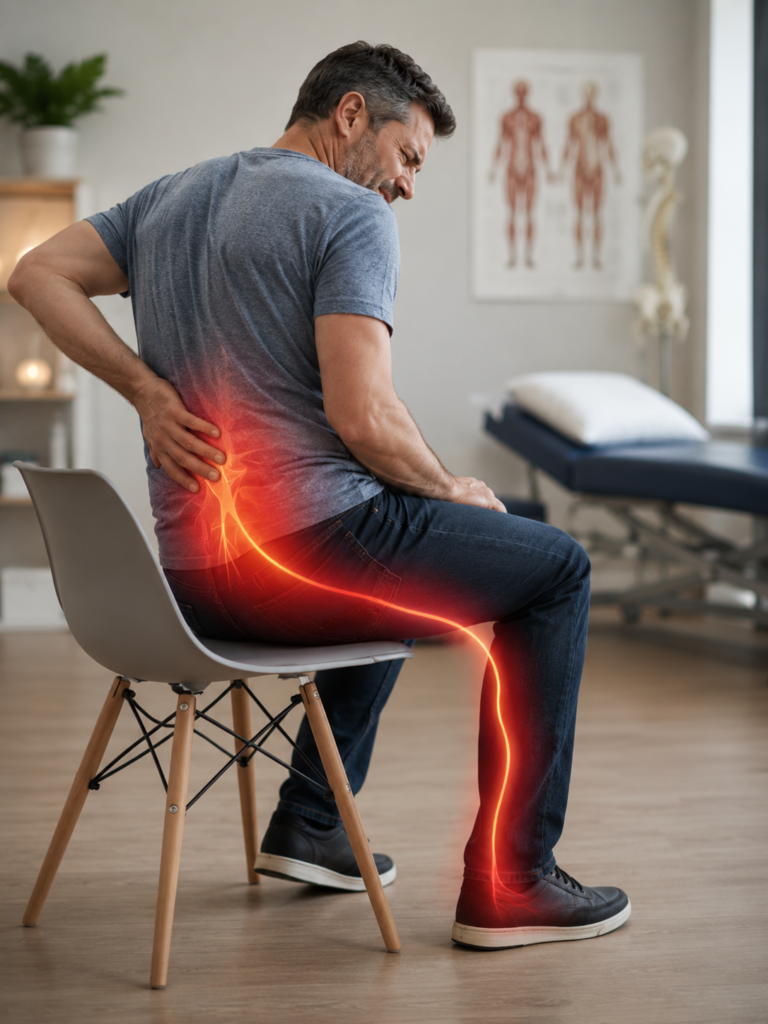
Sciatica treatment in Montreal
Clinique TAGMED Montréal / Mont-Royal Traitement de la sciatique à Montréal Examen gratuit — valeur de 85 $ CADemander mon examen gratuitVoir les disponibilitésDemandez…

Patellar and Achilles reflexes in sciatica: what can they indicate?
TAGMED Clinic Montreal / Mount Royal — Patellar and Achilles reflexes in sciatica: what can they indicate? Understanding what this diagnostic sign can contribute…
Sciatica aggravated by coughing or sneezing: why does the pain increase?
TAGMED Clinic Montreal / Mount Royal — Sciatica aggravated by coughing or sneezing: why does the pain increase? Clinical pointers, signs to monitor and next…

Sciatica after moving house or exertion: why pain sometimes appears the next day
TAGMED Clinic Montreal / Mount Royal — Sciatica after moving house or exertion: why pain sometimes appears the next day. Clinical pointers, signs to…
Sciatica on waking: why pain is sometimes worse in the morning
TAGMED Clinic Montreal / Mount Royal — Sciatica on waking: why pain is sometimes worse in the morning. Clinical pointers, signs to monitor and…
Sciatica and driving: why sitting in a car sometimes aggravates pain
TAGMED Clinic Montreal / Mount Royal — Sciatica and driving: why sitting in a car sometimes aggravates pain. Clinical pointers and signs to monitor…