TAGMED Clinic | Specialized Osteopathy and Advanced Technologies
Foraminal stenosis: when the nerve tunnel becomes too narrow
Foraminal stenosis is one of the most common causes of pain that travels down the leg or arm, yet it is also one of the least understood by patients.
Many patients receive an MRI report mentioning "foraminal stenosis", "foraminal narrowing", "foraminal impingement", "foraminal disc protrusion", "uncovertebral osteoarthritis" or a "disc-osteophyte complex" without really understanding what these terms mean. Yet these words may explain very real pain: sciatica, femoral nerve pain, neck pain radiating into the arm, numbness, burning, tingling or reduced tolerance for certain positions.
The foramen is the small tunnel through which a nerve root exits the spine. When this tunnel becomes too narrow, the nerve may lack space, become irritated or become more sensitive to movement, posture and everyday loads. Pain may then be felt far from the spine: in the buttock, leg, foot, shoulder, arm, hand or fingers.
The challenge is that foraminal stenosis often sounds less dramatic in everyday language than a "large herniated disc". Yet it can be extremely painful, especially when it directly affects the path of a nerve root.
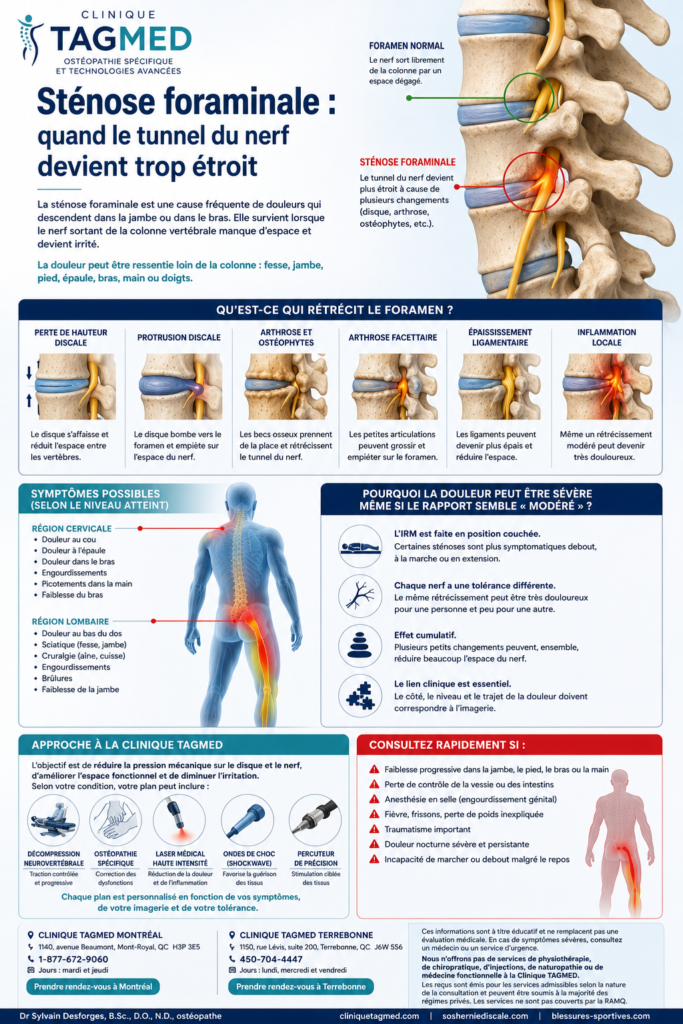
Understanding the foramen
What is foraminal stenosis?
The word "foramen" means a natural opening. In the spine, each nerve leaves the spinal canal through a small passage between two vertebrae. This passage is called the intervertebral foramen.
Foraminal stenosis means that this passage has become narrower. The nerve then has less room to exit the spine freely. This narrowing can be mild, moderate or severe. It may affect one or both sides. It can occur in the neck, lower back or, less commonly, the thoracic region.
In simple terms, foraminal stenosis means that the nerve's tunnel has become too tight. It is not always the spinal cord that is compressed; in many cases, it is the nerve root as it exits the spine.
The key point
Foraminal stenosis can cause significant pain even if the report does not mention a large herniated disc. What matters is the space available for the nerve and the relationship between the narrowing seen on imaging and the patient's symptoms.
Why the nerve lacks space
What narrows the foramen?
The foramen can become narrower for several reasons. In most cases, it is not one isolated factor but a combination of mechanical changes. A disc protrusion, loss of disc height, osteoarthritis, bone spurs or local inflammation can all contribute to a lack of space around the nerve.
This is why some MRI reports describe several "moderate" abnormalities even though the patient has severe pain. Each factor on its own may seem limited, but their combined effect can considerably reduce the space through which the nerve exits.
Loss of disc height
When a disc collapses or becomes dehydrated, the space between the vertebrae decreases. The foramen can then gradually narrow around the nerve.
Disc Protrusion
A protrusion located near the foramen can push towards the nerve's tunnel and contribute to nerve root irritation.
Bone spurs
Bone spurs associated with osteoarthritis can take up space in the foramen and narrow the passage for the nerve.
Facet arthrosis
The small joints at the back of the spine can enlarge, become inflamed or change the local mechanics.
Ligament thickening
Some supporting tissues can thicken over time and contribute to narrowing.
Local inflammation
Even moderate narrowing can cause symptoms if the nerve is irritated, inflamed or hypersensitive.
Common confusion
Why the report sometimes refers to stenosis rather than a herniated disc
Many patients look for the words "herniated disc" in their MRI report. When they do not see them, they believe their pain cannot come from a disc or the spine. Yet a report may refer to foraminal stenosis, a disc protrusion, disc disease or a disc-osteophyte complex without using the word "herniation".
In many cases, the problem is not simply a disc bulging backwards. The problem is the space available for the nerve root. A moderate protrusion, combined with loss of disc height and osteoarthritis, can cause foraminal stenosis that significantly irritates the nerve.
The patient may then be told that the MRI shows "nothing major" because there is no large central herniation. But if the foramen is narrowed on the same side as the pain, at the level corresponding to the nerve's path, this information can be very important.
The real issue
The question is not only: "Is there a herniated disc?" The real question is: "Does the nerve have enough room to exit the spine without becoming irritated?"
Possible symptoms
How foraminal stenosis can present
When a nerve root is irritated within the foramen, pain can be felt farther away. This explains why a lower back problem can cause pain in the buttock, thigh, calf or foot. Similarly, a neck problem can cause pain in the shoulder, arm, forearm, hand or certain fingers.
Symptoms vary according to the affected level, the side involved and the severity of the narrowing. They may be constant or intermittent. They may increase with certain positions, such as prolonged standing, walking, back extension or certain neck movements.
Radiating pain
Pain that travels down the leg or arm, sometimes along a distinct path.
Numbness
A sensation of numbness, tingling or loss of sensation in a nerve territory.
Burning sensations
A burning, hot or electric-shock sensation, or neuropathic pain.
Weakness
A feeling that the leg, foot, arm or hand is not responding as well.
Pain when walking
Pain or heaviness that develops after a few minutes of walking or standing.
Positional pain
Symptoms worsened by some positions and relieved by others.
Lower back
Lumbar foraminal stenosis: why pain travels down the leg
In the lumbar region, foraminal stenosis can irritate the nerve roots involved in sensation and muscle control in the leg. Depending on the affected level, the patient may feel pain in the buttock, hip, groin, front of the thigh, side of the leg, calf, top of the foot or sole of the foot.
For example, foraminal involvement at L4-L5 or L5-S1 may sometimes be associated with sciatica-like pain. Involvement higher up, such as L2-L3 or L3-L4, may sometimes cause pain towards the front, in the groin or front of the thigh, often mistaken for a psoas or hip problem.
Leg pain does not always originate in the leg
When a nerve is irritated as it exits the spine, pain can be felt farther down the limb. This is why the path of the pain must be related to the level described in the imaging report.
Neck and arm
Cervical foraminal stenosis: why pain travels down the arm
In the neck, foraminal stenosis can irritate a nerve root that travels towards the shoulder, arm, forearm, hand or fingers. This is why a patient may seek care for arm pain even though the main problem is in the neck.
This situation can be confused with shoulder tendinitis, carpal tunnel syndrome, muscle pain or trapezius tension. These conditions may be present, but cervical nerve irritation should also be considered when the pain follows a path, is accompanied by numbness or varies with neck movements.
An important clue
If arm pain increases or decreases with the position of the neck, or if it is accompanied by tingling in certain fingers, a cervical foraminal component should be considered during the assessment.
MRI and symptoms
Why the report may sound moderate when the pain is severe
A common mistake is to assume that pain severity must always match the severity of the wording in the report. It is not that simple. Moderate foraminal narrowing can be very painful if the nerve is inflamed or if the narrowing occurs in precisely the wrong place.
MRI is generally performed while lying down. However, some cases of foraminal stenosis cause more symptoms when standing, walking or extending the spine. A patient may therefore experience more pain in everyday life than a static image appears to suggest.
This is why an assessment should not stop at the words "mild", "moderate" or "severe". It must consider the level, side, symptom pattern, duration of the problem, tolerance for different positions and treatments already tried.
An overly quick reading
- The report says "moderate".
- The word "herniation" does not appear.
- The pain is considered minor.
- The patient receives general advice.
- The mechanical problem remains poorly understood.
Biomechanical reading
- The foramen is assessed as a nerve tunnel.
- The affected side is compared with the symptoms.
- The path of the pain is checked.
- The loss of disc height is taken into account.
- The plan is adapted to the actual mechanics.
Herniated discs, disc disease and osteoarthritis
Why foraminal stenosis often has multiple causes
Foraminal stenosis does not always develop overnight. It can develop gradually as a disc loses height, the posterior joints become arthritic, bone spurs form and the disc begins to bulge towards the foramen.
This is why patients in their 40s, 50s, 60s or older may have a report mentioning several terms: degenerative disc disease, facet joint osteoarthritis, disc protrusion, foraminal narrowing, bone spurs, disc space narrowing or a disc-osteophyte complex. These terms are not contradictory: they often describe different parts of the same mechanical problem.
A disc losing height
The disc gradually collapses, reducing the space between the vertebrae.
A narrower foramen
The tunnel through which the nerve exits becomes less spacious.
Osteoarthritis and bone spurs
Bony structures can take up more room around the nerve.
Disc Protrusion
The disc can push backwards or towards the side of the foramen.
Nerve irritation
The nerve root becomes more sensitive to movement and position.
Radiating pain
Symptoms can travel down the leg or arm.
Spinal decompression therapy
Why decompression may be considered in some cases of foraminal stenosis
At TAGMED Clinic, neurovertebral decompression is considered when the assessment suggests a disc, foraminal or nerve-related component that may be influenced by reducing mechanical pressure. The aim is not to "treat a report", but to improve the mechanical environment around the disc and nerve structures when appropriate.
Spinal decompression uses controlled, progressive and personalized traction. It aims to reduce certain stresses on the intervertebral discs and nerve roots. In some cases, it may be included in a plan that also involves specific osteopathy, Class IV medical laser therapy, shockwave therapy or a precision percussion instrument, depending on the patient's condition.
However, it must be clear that not all cases of foraminal stenosis respond in the same way. Long-standing, severe stenosis with a substantial bony component does not behave like a more dynamic stenosis associated with loss of disc height, a protrusion or local inflammation. This is why the initial assessment is essential.
Reduce pressure
The goal is to reduce certain mechanical stresses on the disc and nerve root.
Improve functional space
Controlled traction aims to support a better mechanical environment around the affected segment.
Adapt the plan
Treatment is personalized according to imaging, symptoms, how long the condition has been present and the patient's tolerance.
Clinical objective
The goal is to develop a coherent plan: understand the narrowing, relate the imaging to the symptoms and determine whether a nonsurgical, noninvasive approach may be indicated.
When to consult
When an assessment at TAGMED Clinic may be appropriate
An assessment may be appropriate when an imaging report mentions foraminal stenosis and the symptoms are consistent with nerve irritation. The relationship between the image and the pain must be analysed carefully.
Pain that travels down a limb
Pain in the leg, arm, hand or foot following a nerve pathway.
Suggestive MRI findings
Mention of foraminal stenosis, foraminal protrusion, nerve root contact or a disc-osteophyte complex.
Persistent pain
Symptoms that persist despite several conservative approaches.
Difficulty tolerating positions
Pain worsened by walking, standing, sitting or certain movements.
Neurological symptoms
Numbness, burning, tingling or a feeling of weakness.
Frequent relapses
Temporary improvements followed by a rapid return of pain.
Do not dismiss it
Foraminal stenosis can be more significant than it appears
The word "stenosis" may sound technical and less worrying than a herniated disc. Yet what matters to the nerve is not the word used, but the actual space available. A nerve that lacks space can become sensitive, inflamed and painful.
The opposite mistake must also be avoided: foraminal stenosis is not automatically responsible for every symptom. Some cases are long-standing, stable or cause few symptoms. This is why the report, pain pattern, functional examination and the patient's actual limitations must all be assessed.
Avoid both extremes
Foraminal stenosis should neither be automatically dismissed nor automatically blamed for all pain. Assessment must be individualized, cautious and related to the clinical context.
TAGMED Approach
An assessment focused on nerve and disc mechanics
At TAGMED Clinic, we look beyond a single word in a report. We analyse the relationship between foraminal stenosis, disc protrusion, disc disease, pain, aggravating movements, radiating symptoms, walking tolerance and treatments already tried.
This approach helps explain why a patient may have significant pain even when the report sounds moderate. It also helps determine whether a nonsurgical, noninvasive care plan may be appropriate for the patient's condition.
A personalized approach
Every patient is different. Two people may have similar foraminal stenosis on MRI, but very different pain depending on inflammation, posture, mobility, how long the condition has been present and nerve sensitivity.
FAQ
Frequently asked questions about foraminal stenosis
What is foraminal stenosis?
It is a narrowing of the tunnel through which a nerve root exits the spine. This lack of space can irritate the nerve and cause radiating pain.
Is it the same as a herniated disc?
No, but the two can be related. A herniation, protrusion or loss of disc height can contribute to foraminal stenosis.
Why does my leg hurt if the problem is in my back?
Because the nerve irritated in the lower back travels towards the leg. Pain can therefore be felt far from the spine.
Why does my arm hurt if the problem is in my neck?
Cervical nerve roots travel towards the shoulder, arm and hand. Cervical foraminal stenosis can therefore cause upper limb pain.
Can moderate foraminal stenosis be very painful?
Yes. Pain depends on the location, contact with the nerve, inflammation, posture and nerve sensitivity.
Is foraminal stenosis always clearly visible on MRI?
MRI shows the structures well, but it is generally performed while lying down. Some pain is worse when standing, walking or in certain positions.
Can neurovertebral decompression be considered?
It may be considered when the assessment suggests a disc, foraminal or nerve-related component that could benefit from reduced mechanical stress. Each case must be assessed individually.
When should you consult a doctor quickly?
Progressive weakness, loss of bladder or bowel control, saddle anaesthesia, fever, severe night pain, significant trauma or loss of the ability to walk requires urgent medical assessment.
Does your report mention foraminal stenosis?
An assessment at TAGMED Clinic can help clarify the relationship between your MRI report, pain, mobility, radiating symptoms and spinal mechanics. When relevant, our approach may include spinal decompression, specific osteopathy, medical laser therapy, shockwave therapy or a precision percussion instrument.
Our clinics
TAGMED Clinic Montreal and Terrebonne
TAGMED Montreal Clinic
1140 avenue Beaumont, Mont-Royal, QC, H3P 3E5
Phone : 1-877-672-9060
Hours: Tuesday and Thursday, 9 a.m. to 6 p.m.
TAGMED Clinic Terrebonne
1150 rue Levis, suite 200, Terrebonne, QC, J6W 5S6
Phone : 450-704-4447
Hours: Monday and Wednesday, 8 a.m. to 6 p.m.
Important note
TAGMED Clinic is a specialized osteopathic clinic using advanced technologies. The information presented on this page is for educational purposes only and does not replace a medical evaluation. In case of severe, new, progressive, or concerning symptoms, consult a doctor or emergency services.
Please note that we do not offer physiotherapy, chiropractic, injections, naturopathy or functional medicine services at the TAGMED Clinic.
Receipts are issued for eligible services depending on the nature of the consultation, particularly in osteopathy, and may be submitted to most private plans according to the terms of your insurance contract. These services are not covered by RAMQ.