

Foot or heel pain?
The problem might be coming from your back.
Are you wearing orthotics, receiving shockwave therapy, or injections for plantar fasciitis, heel spurs, or tarsal tunnel syndrome without success? This is often because the real cause is being ignored. Discover how lumbar nerve compression can have direct repercussions under your foot.
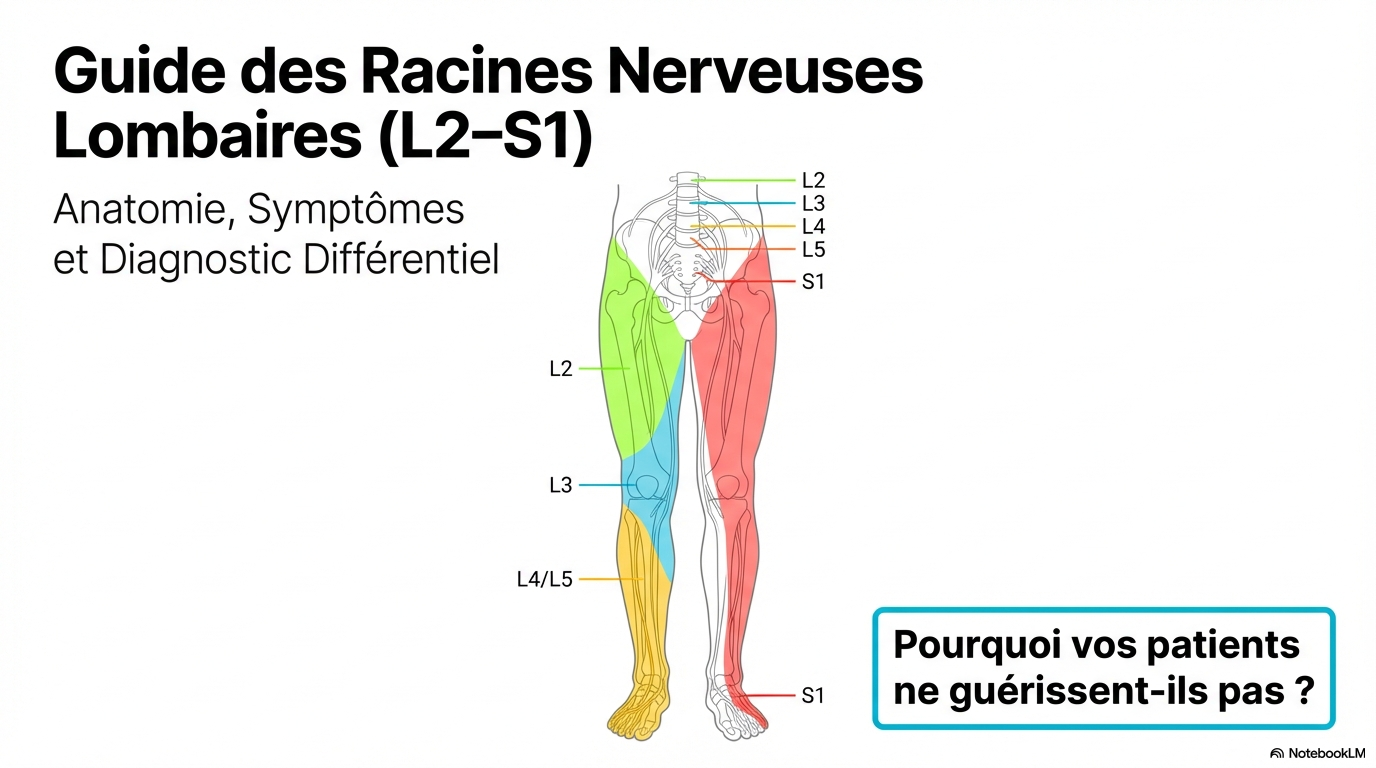
The "Fake" Foot Problem
To persist in treating the arch of the foot or the heel when the nerve sciatica or tibial nerve pinched at its root in the lower back is a very common diagnostic error that condemns patients to chronicity.
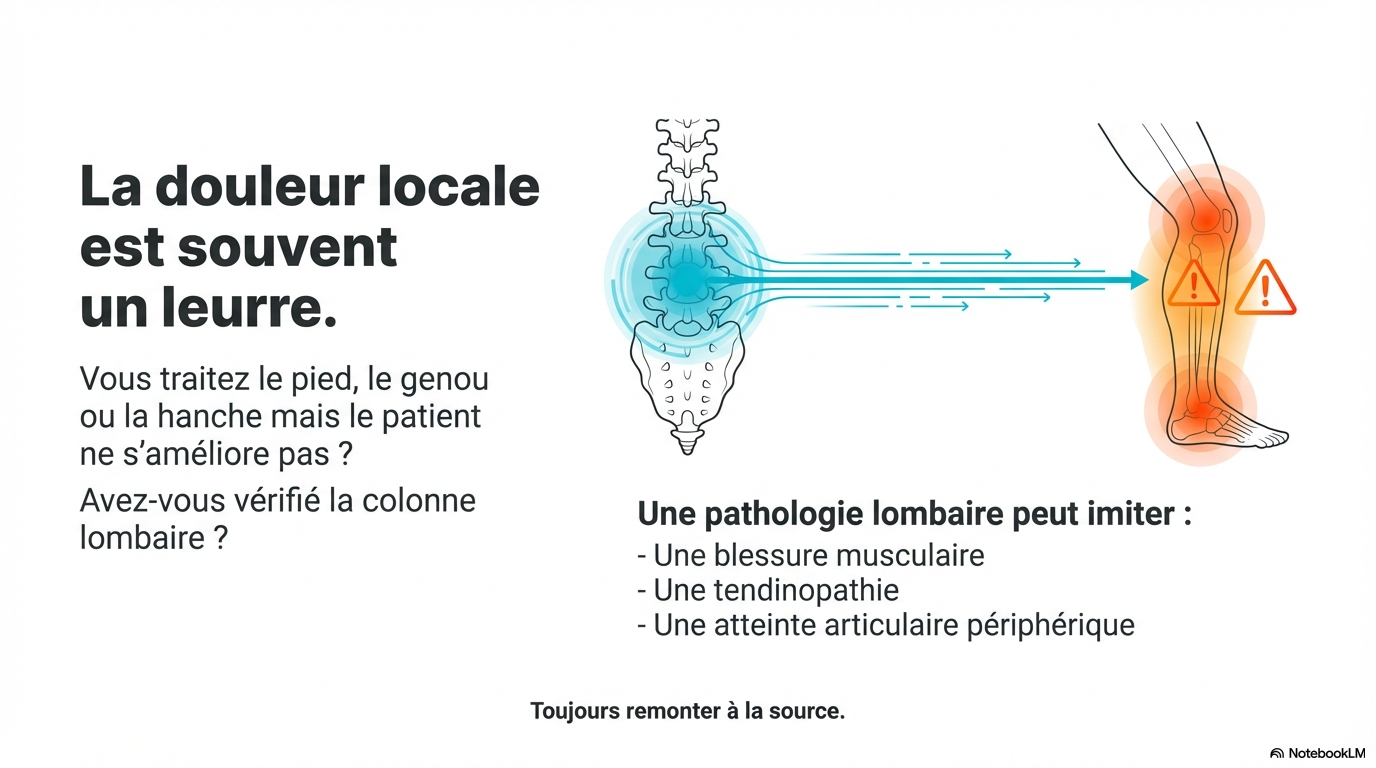
Anatomy & Pathology
The impact of the lumbar nerves on the foot
The nerves that give sensation and strength to your foot, ankle and toes all originate in your lower back (L4 to S1).
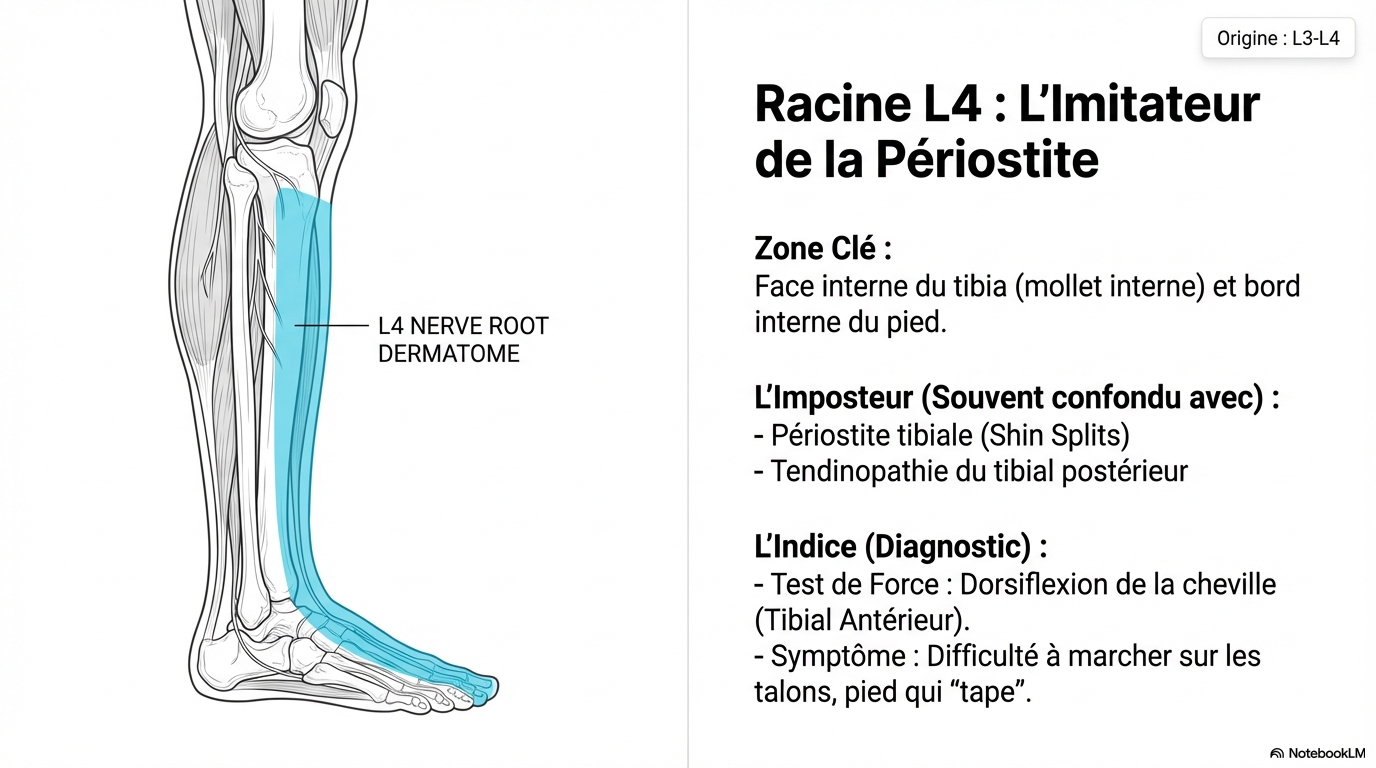
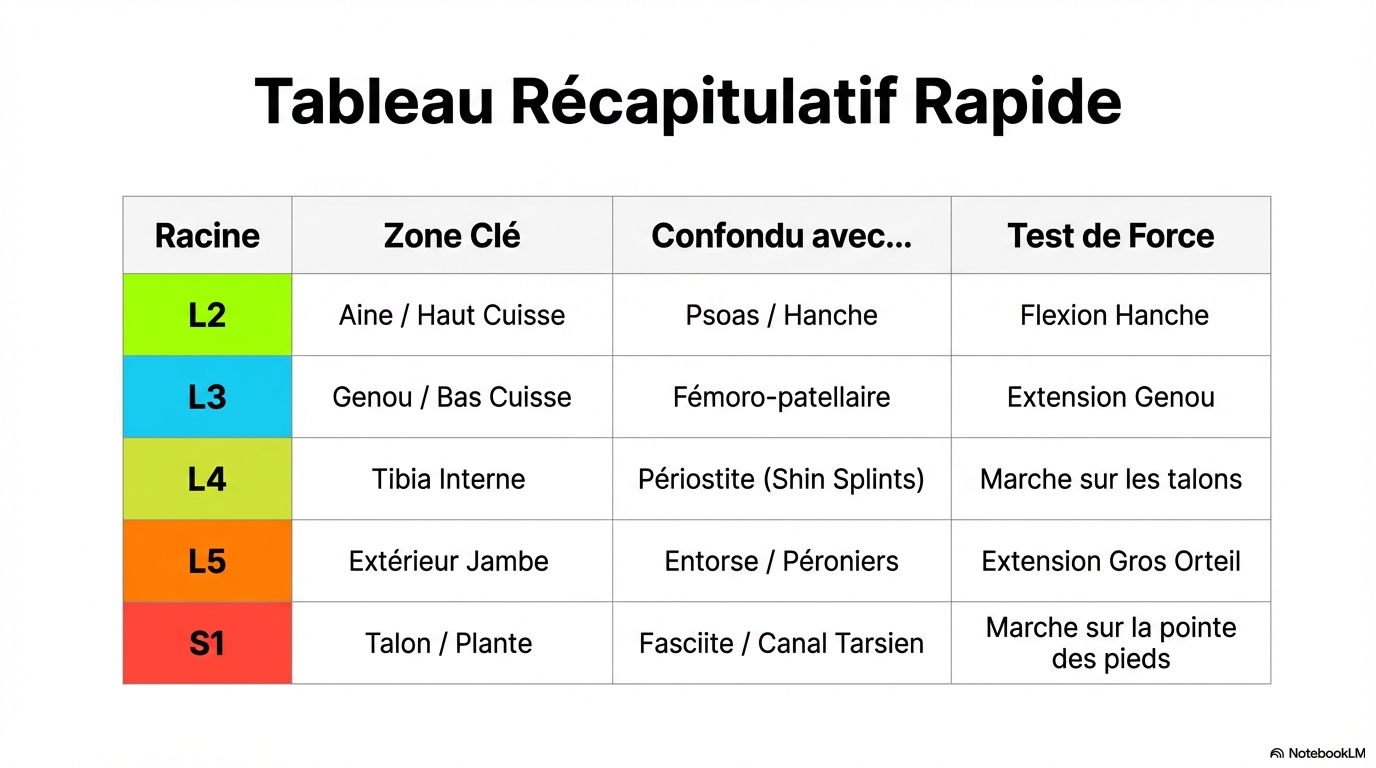
Root L4
Origin: L3-L4Raise the ankle
(Dorsiflexion - Anterior Tibial)
Sensory Zone
Inner surface of the tibia (inner calf) • Inner edge of the foot
False tendinitis
Often confused with posterior tibial tendinopathy or periostitis. The patient has difficulty walking on their heels.
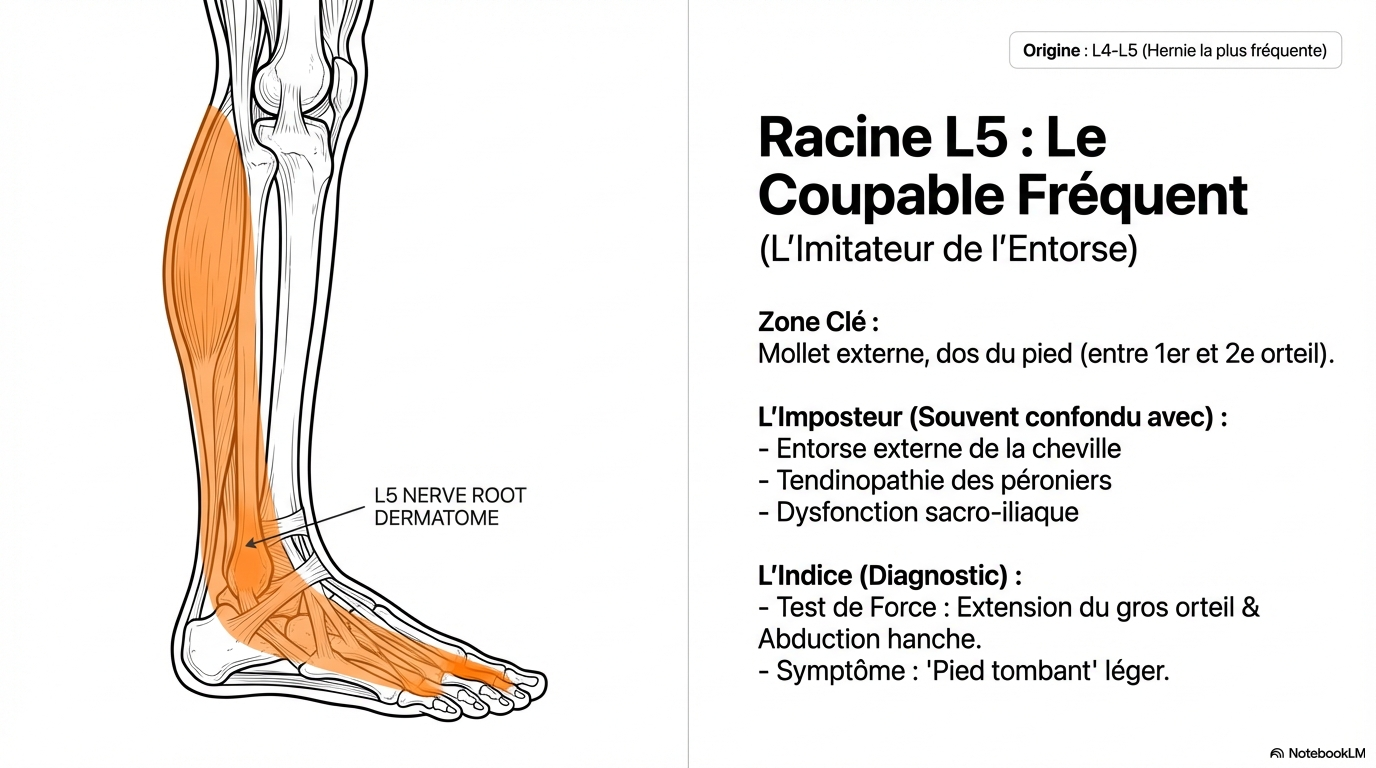
Root L5
Origin: L4-L5Lift your big toe
(Extensor of the big toe)
Sensory Zone
External calf • Top of the foot (between the 1st and 2nd toes)
Imitates the sprain
Severe damage to L5 causes mild "foot drop." This is very often confused with an external ankle sprain or peroneal tendinopathy.
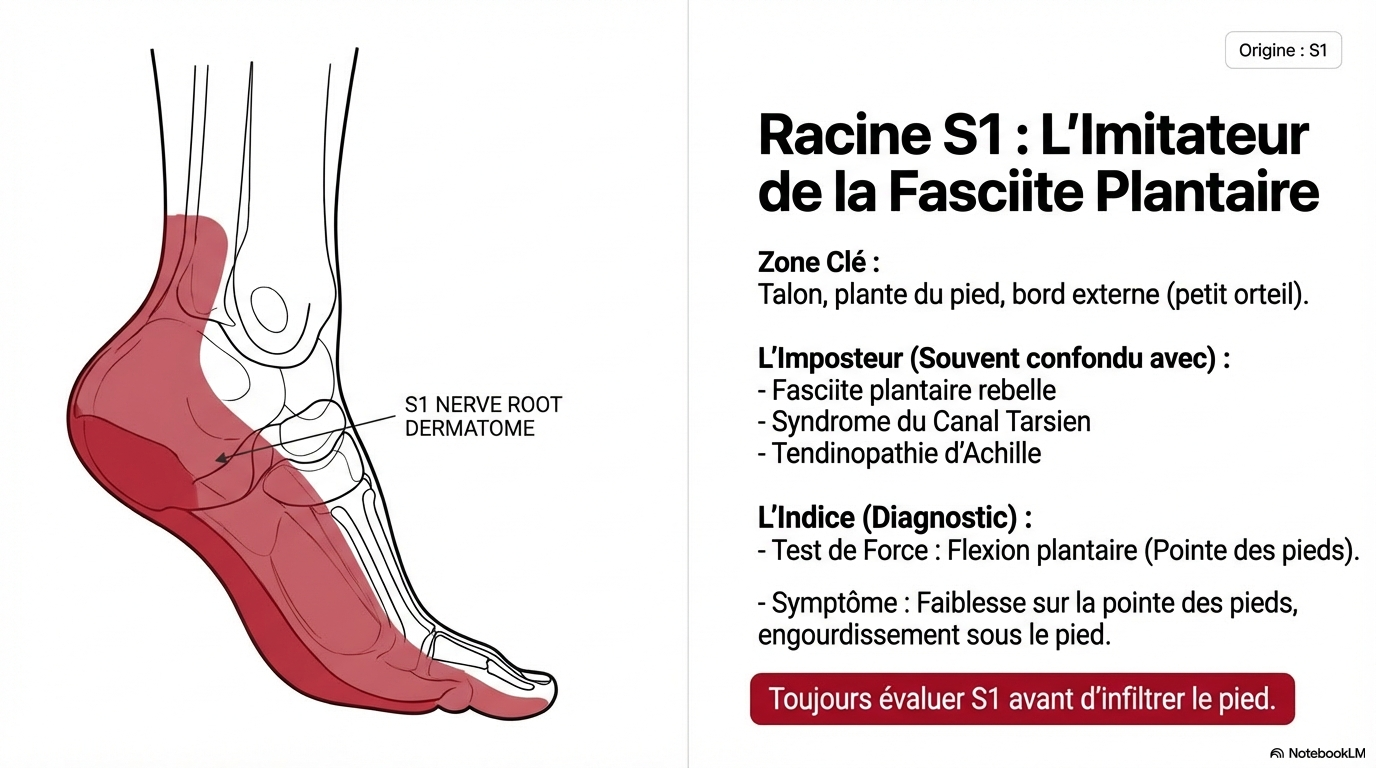
Root S1
Origin: L5-S1Foot Propulsion
(Calf, Plantar flexion)
Sensory Zone
Heel, sole of the foot • Outer edge (little toe)
The Heel Trap
Pain under the foot is frequently misdiagnosed as a heel spur, plantar fasciitis, or tarsal tunnel syndrome. Always assess the S1 level before injecting or operating on the foot.
Differential Diagnosis
Foot or Lower Back? (Or both?)
To avoid unnecessary injections under the heel, it is imperative to determine the exact origin of the pain through a thorough clinical evaluation.
How do we make the diagnosis?
Lumbar MRI vs. Foot Ultrasound
An ultrasound of the foot confirms inflammation of the plantar fascia. But only one lumbar MRI or a neurological assessment will allow us to see if the sciatic nerve (S1) is compressed in your back, which would be the real cause of this inflammation.
Neurological Provocation Tests
We combine foot tests (Tinel's sign in the tarsal tunnel) with back tests (Lasègue's sign/Straight Leg Raise). If bending your back forward or raising your right leg triggers a burning sensation under your heel, the origin is lumbar!
The "Double Crushing" & the Subsidence
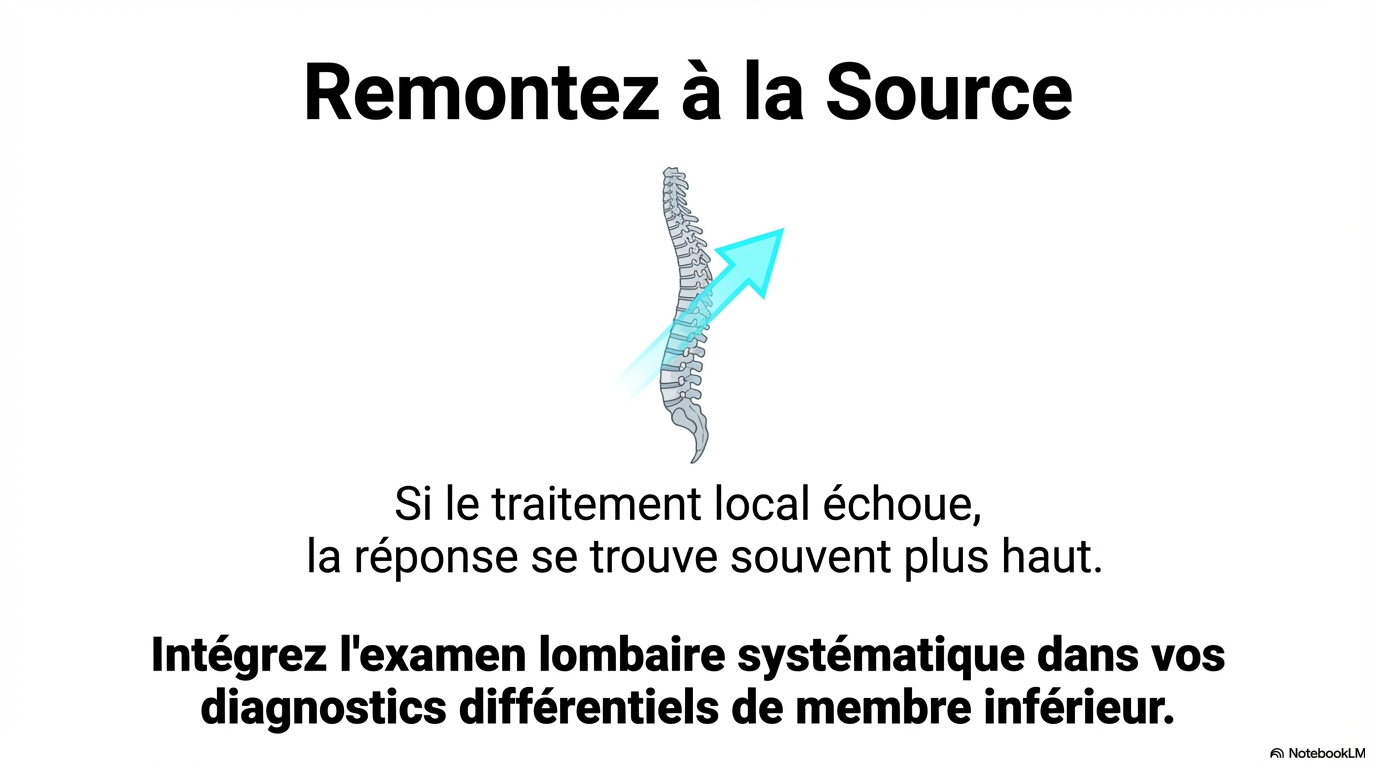
In many cases, the inflammation under your foot (fasciitis) is very real, but it has been provoked and maintained due to a problematic back.
The cascade of foot destruction:
- 1. L5-S1 lumbar herniated disc (often silent in the back)
- 2. Decreased nerve impulses to the small muscles under the foot
- ↓
- 3. The muscles get tired, the arch of the foot collapses
- 4. Extreme overtension on the fascia = Fasciitis & Lenoir's splinter
Why do orthotics alone fail?
An orthosis provides mechanical support to the arch. But if the nerve (the "electrical wire") remains pinched in your back, the muscles in your foot will remain disconnected and weak. The tension on the fascia will inevitably return.
Consequence: Treating the foot alone is a band-aid solution. For a permanent cure, the muscles of the arch of the foot must be "reconnected" by releasing the lumbar nerve root using the Spinal decompression therapy.
The Solution: Spinal decompression therapy
To the At TAGMED Clinic, we target the true neurological source of pain of your feet. If your symptoms originate from sciatic or tibial nerve pain, local treatments for the heel will only offer temporary relief.
The Spinal decompression therapy lumbar is an advanced, non-invasive technology. By creating a computerized and specific stretch of the lower back, it generates intradiscal negative pressure. This shrinks herniated discs, rehydrates the discs, and releases the nerves (L4, L5, S1) that run down to your toes.
Effective for treating lumbar causes of foot pain:
- Double Crushing Syndrome mimicking plantar fasciitis
- S1 radiculopathy referring to pain in the heel (false heel spur)
- Foraminal stenosis or L5-S1 herniated disc constricting the sciatic nerve
- Numbness, burning and tingling under the foot (false tarsal tunnel syndrome)
- Weakness in lifting the foot (L5 involvement)
Do not treat the symptom.
Address the root cause.
Failure of local treatments (orthotics, shockwave therapy to the heel, cortisone injections...)
Specialized lumbar assessment (L4-S1) by a spine expert
Lumbar Neurovertebral Decompression
Sciatic nerve release, restoration of the plantar arch and cessation of heel burning.
Stop the pain in your feet.
Let's check the condition of your lumbar nerves today to put your mind at ease.


 Français du Canada
  English (Canada)