

Leg pain?
The problem often originates in the lower back.
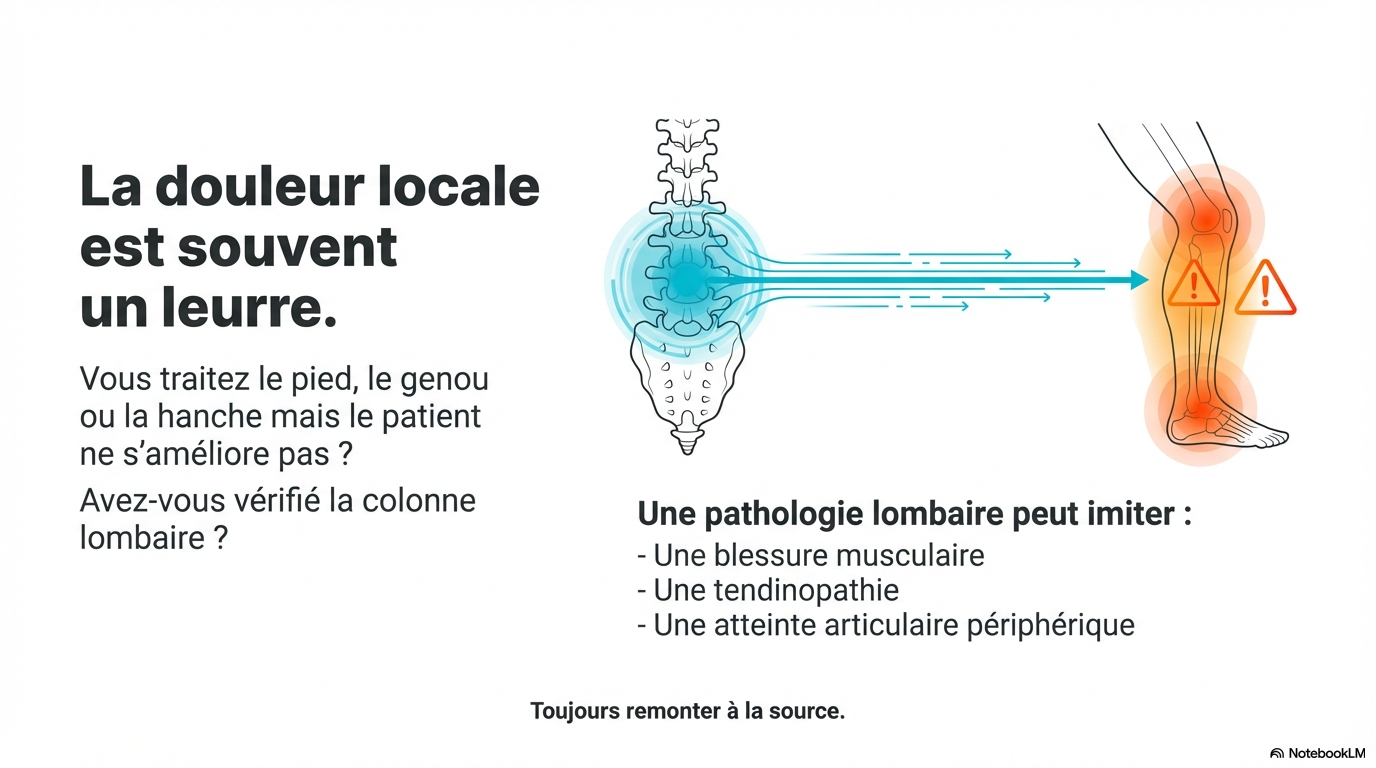
Hip, knee, ankle, or foot... Are you receiving local treatments but the pain persists? This is a classic sign of referred pain. Discover how lumbar nerve compression (sciatica or cruralgia) perfectly mimics joint injuries in the leg.
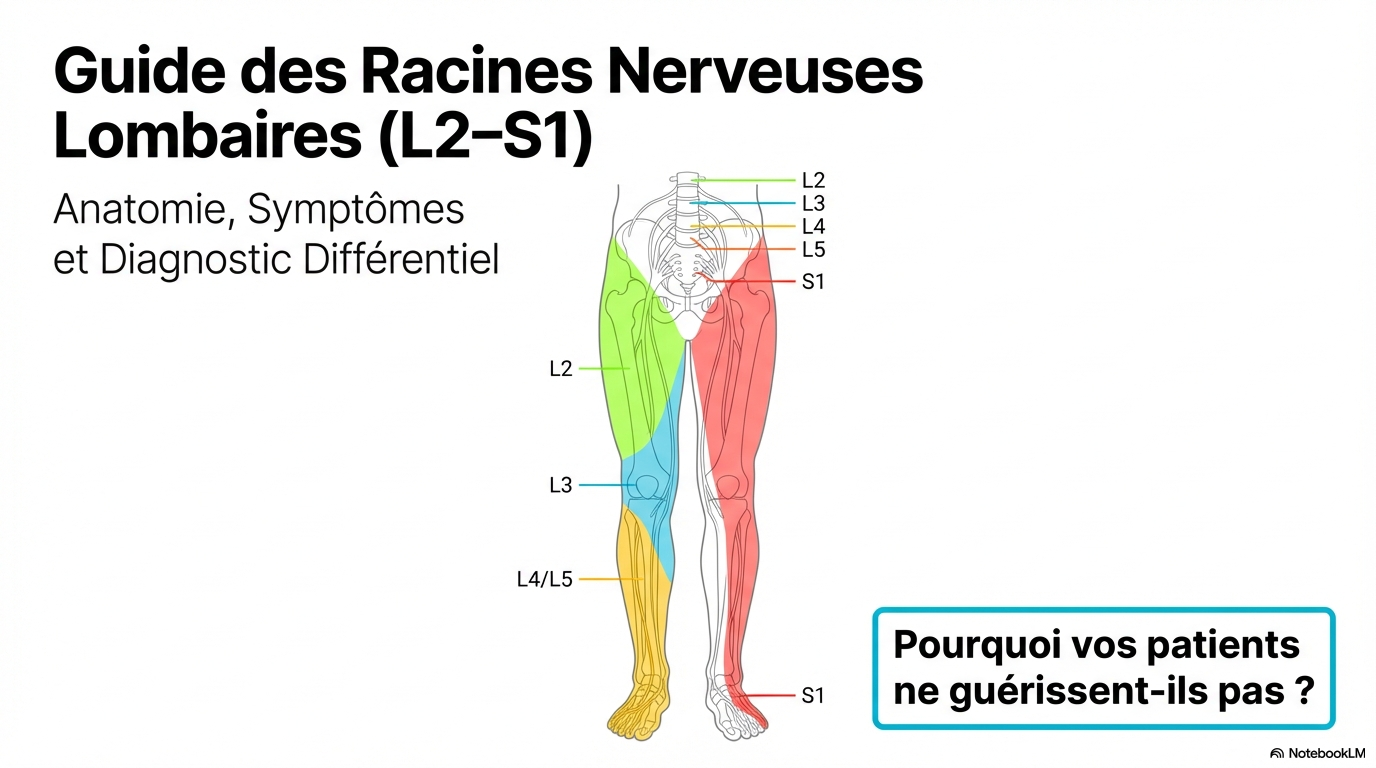
The Great Clinical Trap
The most common diagnostic error in orthopedics is to insist on treating a peripheral joint (hip, knee, foot) with injections or local therapies when the nerve is pinched at its root in the lower back.
Specific Guides
Where does it hurt ?
Select the area of your pain to discover how the lumbar nerves mimic pathologies specific to that joint.
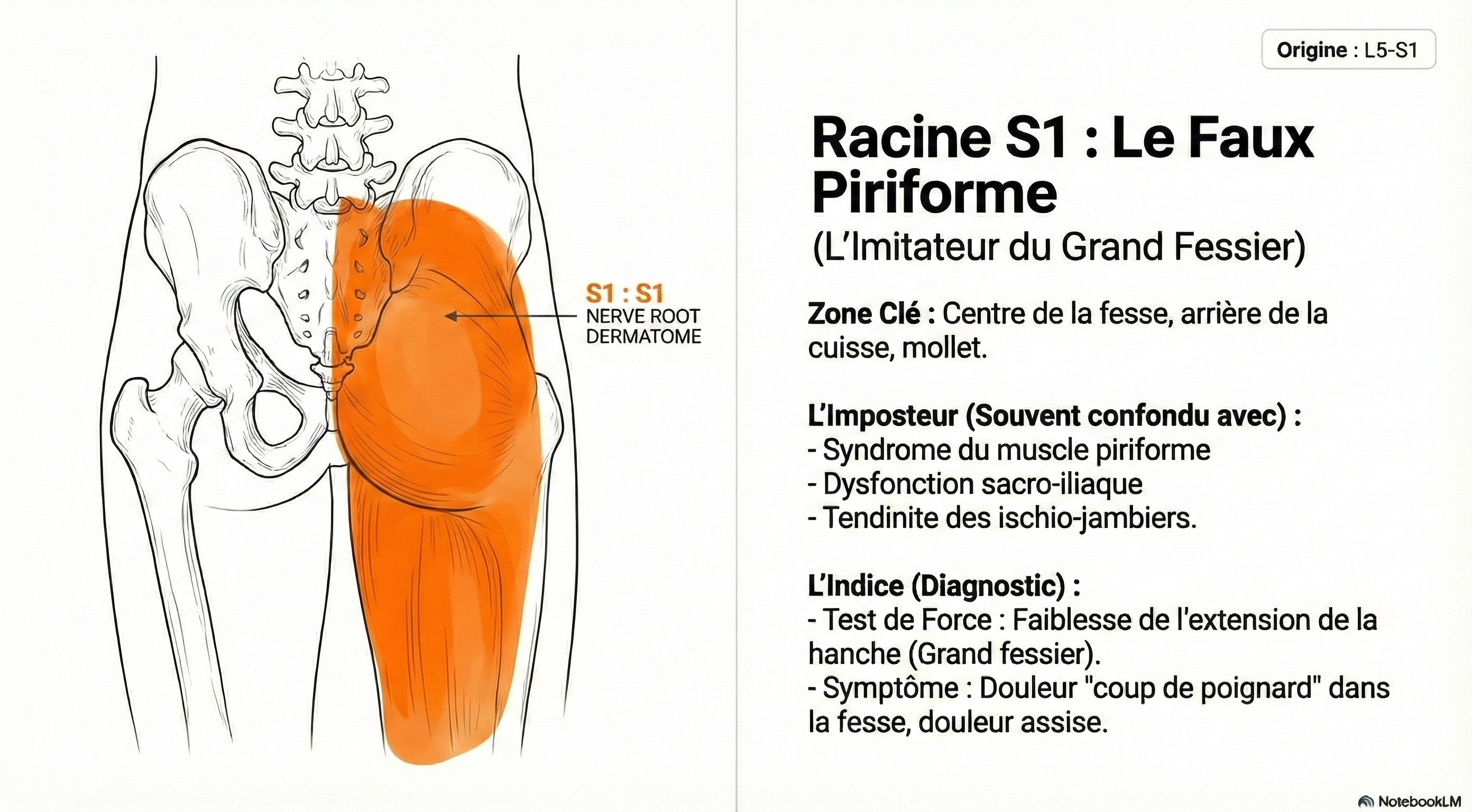
Pelvic & Buttock Pain
Roots involved: L4, L5, S1
It can mimic piriformis syndrome, false trochanteric bursitis, or a sacroiliac joint blockage. If your gluteal massages and stretches fail, the sciatic nerve is often the real culprit.
Consult the Basin guide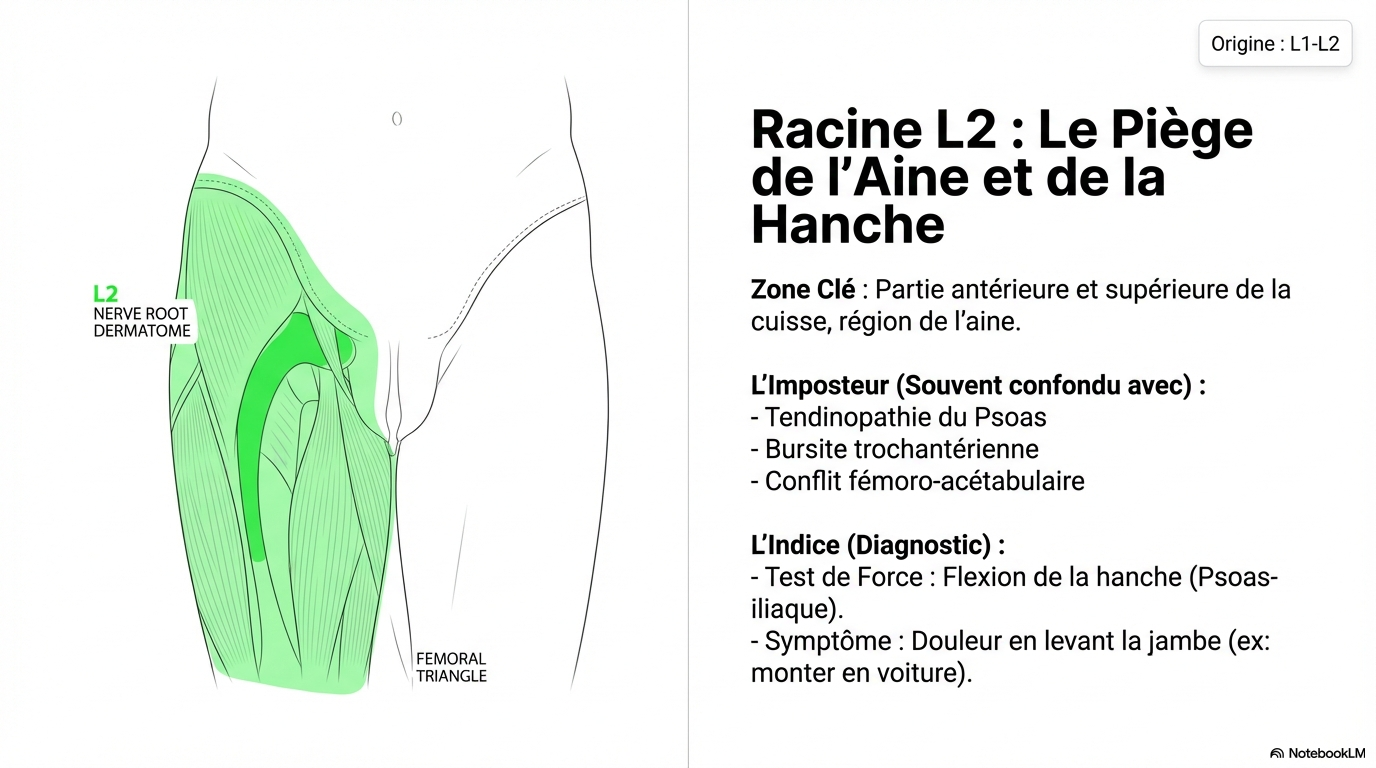
Hip & Groin Pain
Roots involved: L1, L2, L4, L5, S1
It mimics trochanteric bursitis, psoas tendinitis, femoroacetabular impingement, and piriformis syndrome (buttock). If your injections fail, the problem lies higher up.
Consult the Hip Guide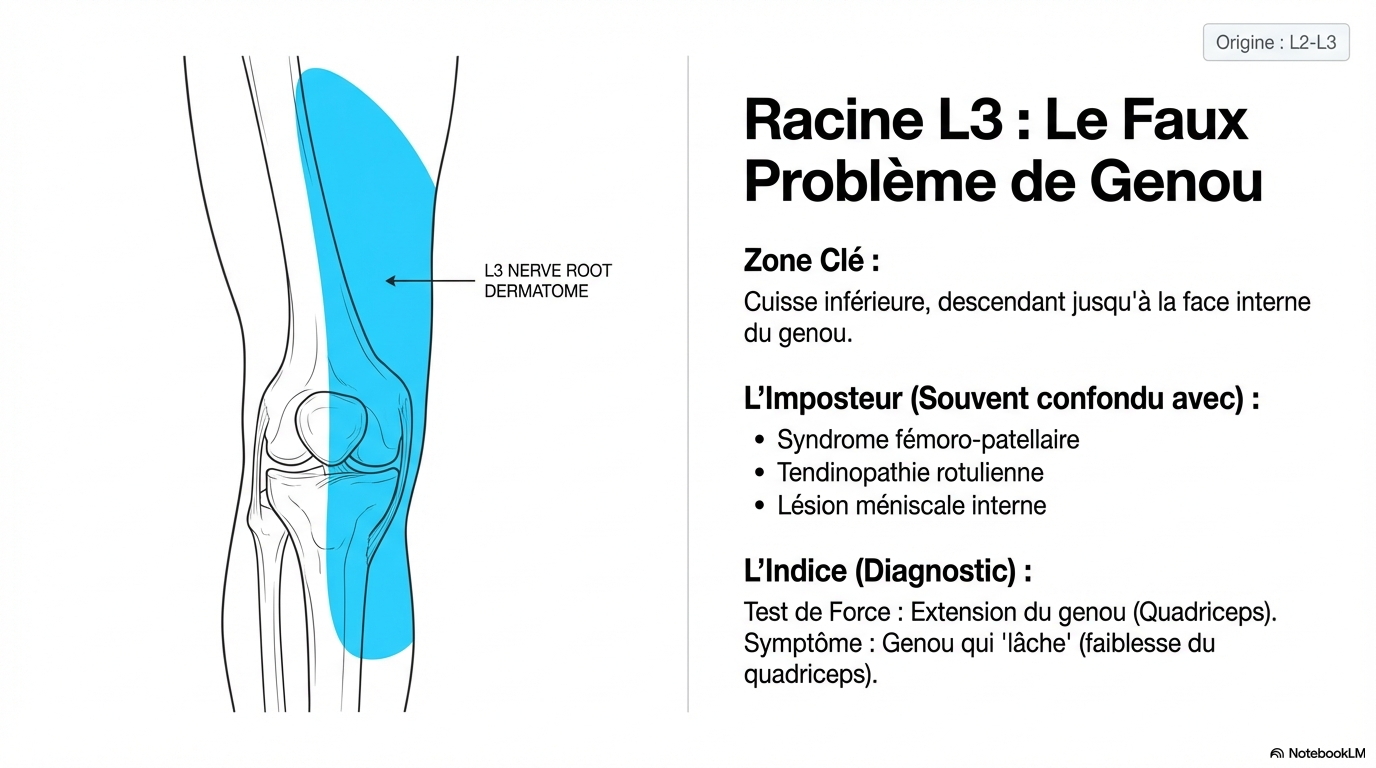
Knee pain
Roots involved: L3, L4, L5, S1
It mimics patellofemoral pain syndrome, patellar tendinitis, medial meniscus tear, or iliotibial band syndrome (IT band syndrome). A knee that "gives way" is often neurologically related.
Consult the Knee Guide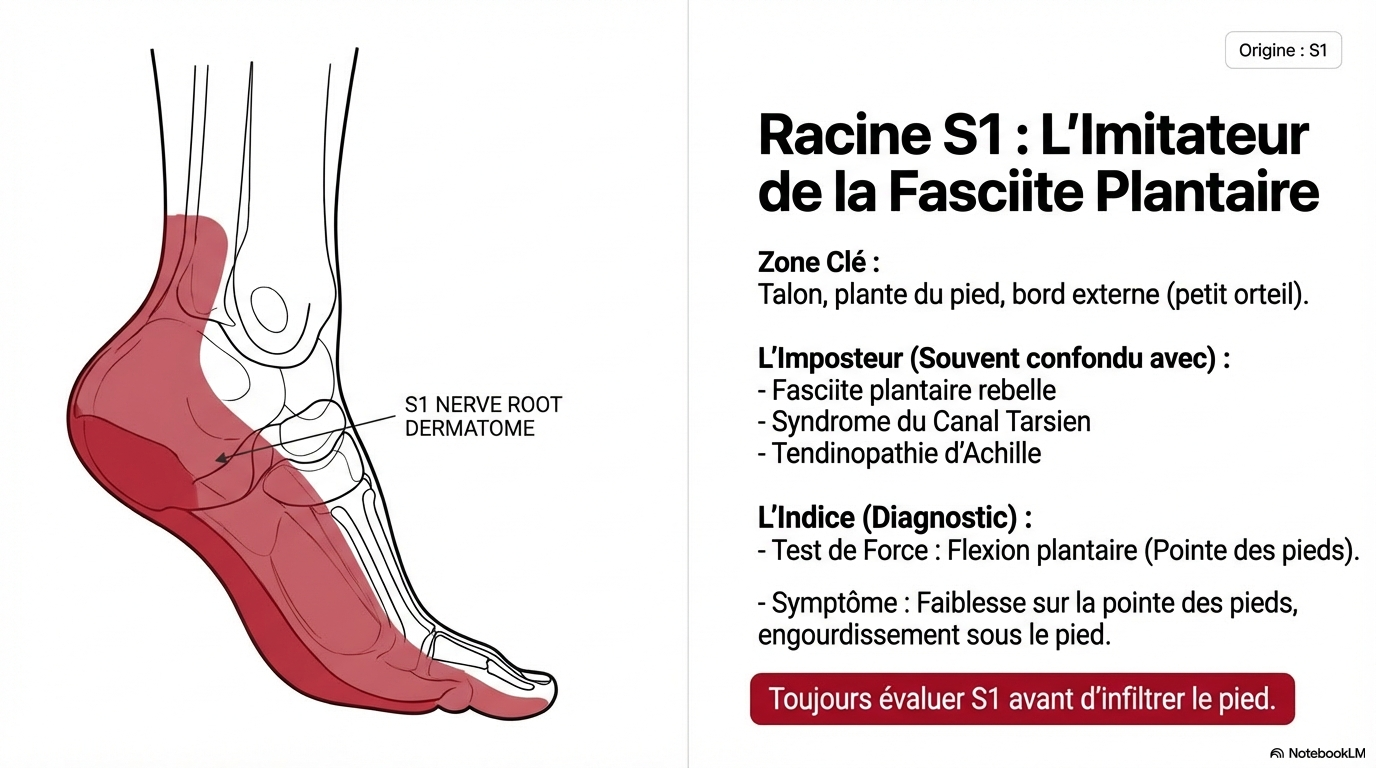
Foot & Heel Pain
Roots involved: L4, L5, S1
It mimics heel spurs, stubborn plantar fasciitis, tarsal tunnel syndrome, and Achilles tendinitis. If your orthotics don't resolve the problem, sciatica is suspected.
Consult the Foot Guide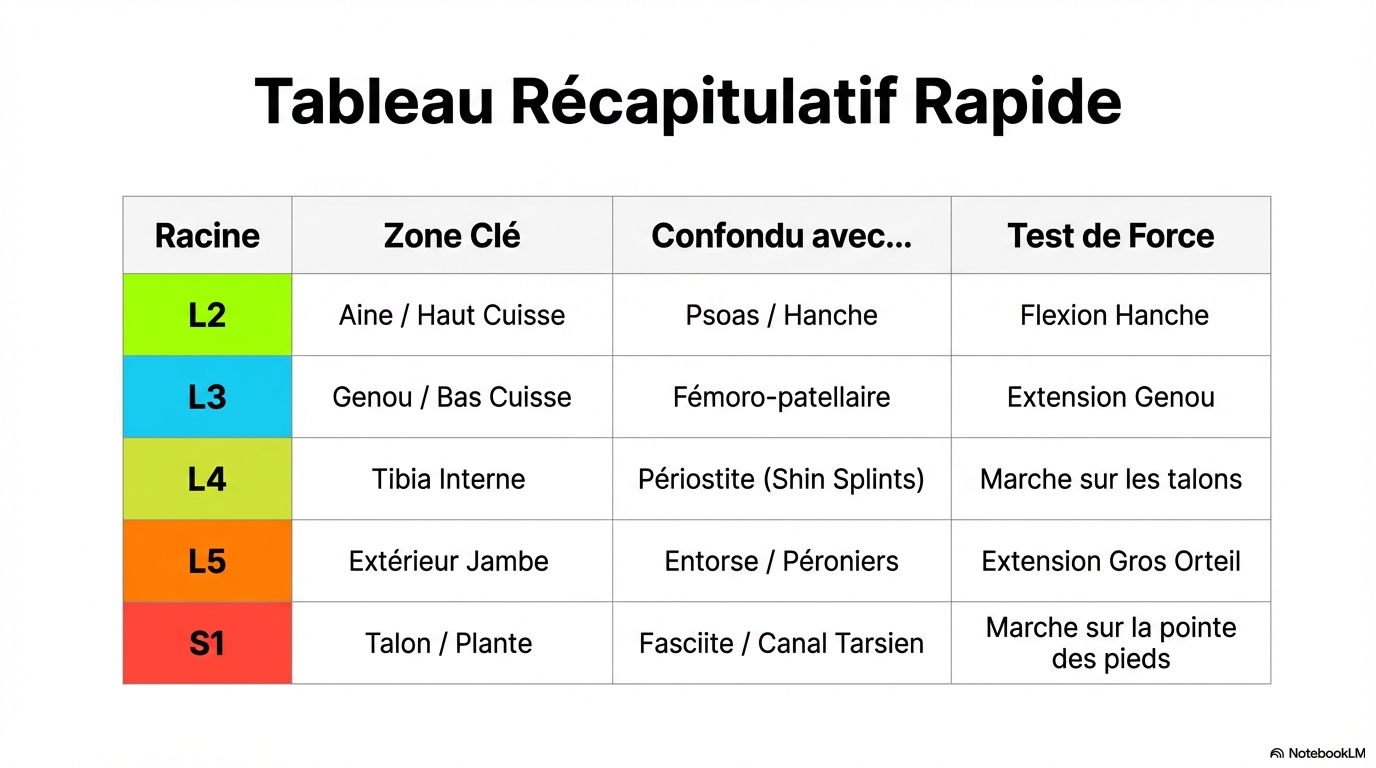
Global Differential Diagnosis
Leg or Back? (Or both?)
Understanding why treatments fail requires an overview of the nervous system.
The importance of lumbar MRI
Local imaging is misleading.
An X-ray of the knee or an ultrasound of the foot will almost always show normal wear and tear (related to age) or slight inflammation. These benign findings are often mistakenly attributed to the cause of your pain. Only a lumbar assessment (or lumbar MRI) allows you to check the condition of the "electrical wiring" (sciatic and femoral nerve).
Cross Neurological Tests
During our clinical examination, we combine joint tests in your leg with nerve tension tests in your back. If stretching the nerve sciatica reproduces your pain whether it was under the heel or at the knee, we found the real cause.
The Domino Effect (Double Crushing)
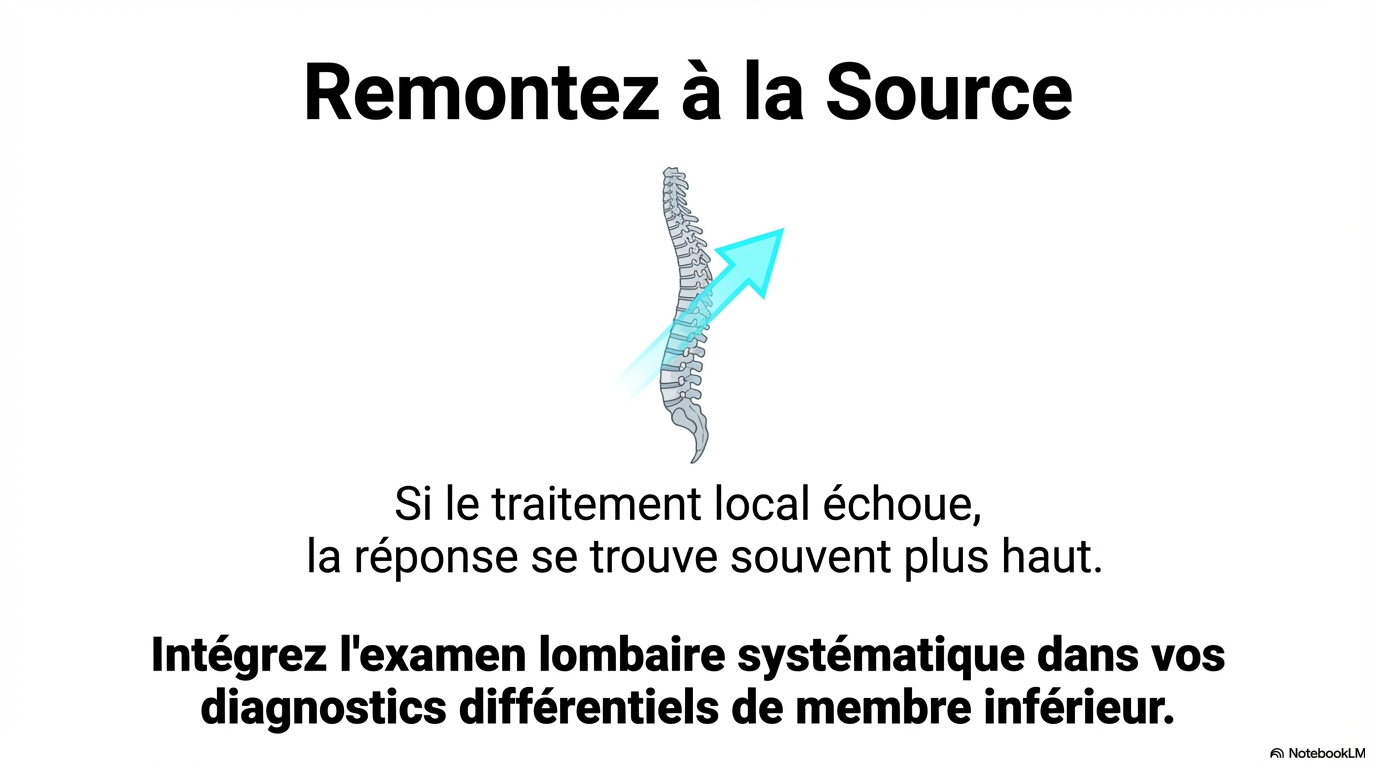
In many cases, the inflammation in your leg (fasciitis, bursitis, tendinitis) is very real, but it has been strictly provoked due to a hidden lumbar problem.
The cascade of leg destruction:
- 1. Lumbar nerve compression (herniated disc, stenosis)
- 2. Loss of electrical impulses to the leg muscles
- ↓
- 3. Muscle weakness, biomechanics collapse (e.g., flat feet, deviated patella)
- 4. Extreme overstress on the tendons = Chronic local pathologies
Why do topical treatments fail?
You can stretch a tendon, wear a knee brace or inject a bursa as much as you want... but if the nerve ("the electric wire") remains pinched in your back, the muscle will remain weak and the injury will continually return.
Consequence: Treating the joint alone is a band-aid solution. For a permanent cure, the system must be "reconnected" by releasing the lumbar nerve root using the Spinal decompression therapy.
The Global Solution: Spinal decompression therapy
To the TAGMED CLINIC, We target the source of instability in your lower limbs. Whether the pain is located in the hip, knee, or foot, if its origin is neurological, it is the back that needs to be treated.
The lumbar neurovertebral decompression This is an advanced, non-invasive technology. By creating a computerized and specific stretch of the lower back, it generates negative intradiscal pressure. This shrinks herniated discs, rehydrates the discs, and frees the nerves that control your entire leg.
Effective for treating lumbar causes of lower limb pain:
- False tendinitis (Psoas, Patellar, Plantar fasciitis, Achilles)
- False bursitis (trochanteric) and refractory Lenoir's spurs
- Piriformis syndrome, numbness and muscle weakness (limping, foot drop)
- Hernia, bulging disc and lumbar foraminal stenosis
Do not treat the symptom.
Address the root cause.
Failure of local treatments (orthotics, knee injections, shockwave therapy, psoas stretching...)
Specialized lumbar assessment of the entire spine (T12 to S1)
Lumbar Neurovertebral Decompression
Release of the nervous network (femoral/sciatic) and restoration of the complete biomechanics of the leg.
Stop the progression of your pain.
Let's check the condition of your lumbar nerves today to put your mind at ease.


 Français du Canada
  English (Canada)