CLINIQUE TAGMED · MONTREAL
Spinal Decompression Treatment in Montreal.
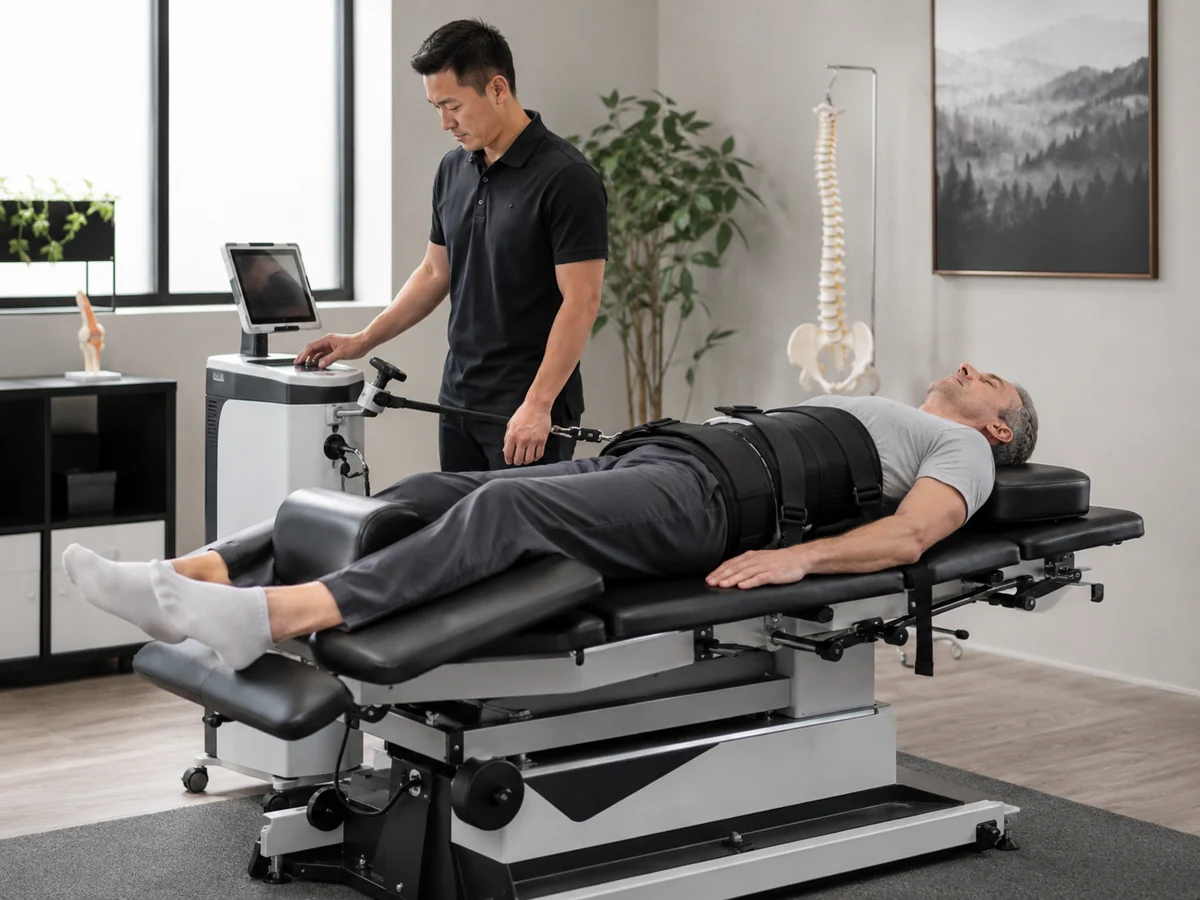
The spinal decompression described here is non-surgical motorized traction of the spine. A device applies controlled tension and adapted positioning to the neck or lower back. It is a care option to discuss after assessment, rather than a disease or a diagnosis. 9
An assessment to discuss your situation, relevant options and precautions.
Book an appointment in MontrealUnderstand the care pathway
1140, avenue Beaumont
Mont-Royal (Québec) H3P 3E5
Tuesday and Thursday, 9 a.m. to 6 p.m., by appointment.
YOUR CLINIC
Your consultation in Montreal
For your Tuesday or Thursday visit in Mont-Royal, prepare a brief symptom history, the documents you already have and one specific activity that has become difficult. Travel, desk work and clinic hours are part of preparing for the visit.
Your clinic
1140, avenue Beaumont
Mont-Royal (Québec) H3P 3E5
Tuesday and Thursday, 9 a.m. to 6 p.m., by appointment.
The right booking calendar
Use Medexa for Montreal / Mont-Royal and check the selected clinic and practitioner.
THE TREATMENT
Understanding non-surgical decompression
The word “decompression” describes the intention to temporarily alter mechanical stresses through distraction and positioning. It does not mean that a nerve has definitely been freed or a disc repaired. The choice depends on the plausible cause of symptoms, the examination, precautions and other options. A herniation, neck pain or osteoarthritis in your records is not enough to make this treatment appropriate. 9 3 4
Traction and decompression surgery
Traction is applied through external supports, without an incision. Surgery may remove part of a disc or bone to relieve pressure on a nerve structure. The indications and risks differ. A table does not replace a surgical opinion when one is needed. 9 2
Traction and active rehabilitation
Traction is a passive intervention; active rehabilitation gradually builds capacity through adapted movement and exercise. Possible relief on the table does not replace returning to activities. Depending on the situation, the plan may prioritize education, exercise or other care. 9 2
An irritated nerve root can produce pain in an arm or leg. This differs from mainly local pain and from spinal cord involvement in the neck. Loss of strength, clumsy hands or an unusual walking pattern requires a specific assessment; pain intensity alone cannot establish how well the nerves are functioning. 3 5
THE ASSESSMENT
Connecting your history, examination and imaging
Assessment first aims to understand your situation and choose a direction for care. It must go beyond checking whether you can lie on the table. Bring your existing reports and information about the care you have already received. 2 9
01 · Clarify the main problem
Describe the onset, symptom pattern, limited activities and response to previous care. Report operations, implants, medications and health changes so that precautions can be checked before any treatment is proposed. 2 9
02 · Relate findings to the region
The examination may include movement, walking, sensation, reflexes and strength. For neck symptoms, hand coordination and balance may change the direction of care. A single test does not capture the whole presentation. 2 5
03 · Compare useful options
Discuss the working explanation, the uncertain benefits of traction and the alternatives. Agree on goals and a reassessment point. An investigation or another opinion is considered according to what it could change in care. 1 2
MRI shows discs and nerve tissues, among other structures; X-rays mainly show bones. Findings must fit the symptoms and examination. Imaging is not routine for low back pain, and an abnormality does not amount to a prescription for traction. 2 1
YOUR CLINICAL PROFILE
Determining whether it suits your situation
The question is which option suits your clinical presentation. The DOC’s technical capabilities and listed uses do not prove a benefit for every person. Assessment must also allow for a decision not to use traction. 9
A proposal that needs an explanation
If traction is proposed, ask why your presentation might be suitable, what other options exist and how the response will be judged. For low back pain, NICE advises against offering traction, with or without sciatica; this reservation must be part of the discussion. 1
Reasons to change direction
A contraindication, a non-spinal explanation or neurological worsening may rule out this option. Spinal cord involvement is not a problem to try treating on the table. Temporary relief never removes the need for appropriate follow-up. 9 5
At TAGMED, the DOC device allows distraction and positioning to be adapted to the cervical or lumbar region selected after assessment. The goal discussed is a useful improvement in symptoms and activities. Device settings alone do not demonstrate a lasting effect, disc regeneration or the ability to avoid surgery. 9 10
OUR CARE PATHWAY
Setting goals and reassessing the response
- Improve a specific activity: walking, working, sleeping or using the arm.
- Track pain, sensation and strength separately in the affected region.
- Review the plan according to function and tolerance.
The DOC device allows the position, force and traction cycles to be adjusted. Settings, tolerance and precautions are checked; a device’s technical capabilities do not predict your result. Report any worsening during a session immediately. 9,10


THE SCIENTIFIC EVIDENCE
Possible outcomes and uncertainties
Evidence must be read according to the region, the population studied and the treatment used for comparison. A result for traction combined with exercise does not establish the effectiveness of DOC alone or of every method called “decompression.” 6 7
Explicit reservations about traction
NICE NG59 advises against traction for low back pain, with or without sciatica. In the Thackeray trial, adding mechanical traction to extension-oriented care did not provide greater improvement in pain or disability for patients with signs of lumbar nerve root compression. 1 6
Results differ between trials
In patients with cervical radiculopathy, Fritz and colleagues observed an advantage from adding mechanical traction to exercise at some follow-ups. Young and colleagues found no additional short-term benefit compared with sham traction added to care. These populations do not represent everyone with neck pain. 7 8
A device is not a guarantee
The manual describes DOC operation and precautions; it does not replace a clinical comparison. The cited trials do not support a success rate specific to this device. Interpretation must distinguish changes in symptoms, ability to perform activities and demonstrated anatomical change. 9 6 7
Key point: The discussion should make uncertainties understandable and goals measurable. No individual outcome is guaranteed. Continuing care is decided using functional and clinical measures, with the option of changing direction when improvement is insufficient. The response should remain open to reassessment. 2
WARNING SIGNS
Guidance for your safety
When is urgent assessment needed?
Seeking treatment must not overshadow new signs of significant nerve compression. These situations require immediate assessment; do not wait for a scheduled decompression session. New neurological changes take priority over the routine treatment plan. 3 4
- Urinary retention, new loss of bladder or bowel control, or numbness in the perineum: seek immediate assessment. 3
- Severe or rapidly progressive weakness in one or more limbs, with difficulty getting around: seek immediate assessment. 5
- With neck symptoms, new difficulty walking or sudden loss of hand coordination: seek immediate assessment. 4
Call 911 if immediate assistance is needed.
YOUR QUESTIONS
Frequently asked questions about your care pathway
Is this the same treatment as surgery?
No. Motorized traction uses an external device. Decompression surgery may remove tissue to relieve pressure on a nerve or the spinal cord. Indications differ; a necessary specialist opinion must not be delayed by a trial of traction. 9 2
Is a herniation on MRI enough to begin?
No. Some herniations cause no symptoms. Assessment checks the match with your difficulties, nerve-related signs, history and precautions. The imaging report does not automatically determine a treatment or number of sessions. It must be interpreted in context. 3 9
Is the evidence the same for the neck and back?
No. Trials involve different populations and interventions. Cervical results do not remove NICE’s recommendation against lumbar traction. A benefit observed in a group does not predict your personal response, and the treatment comparison also matters. 1 7
Which other options should be compared?
Depending on the problem, discussion includes information, gradually returning to activities and rehabilitation. Medication requires medical or pharmacy advice. Some situations warrant an injection or surgical assessment. The choice depends on the cause and the signs observed. 2
How can I tell whether the proposal helps?
Choose a measurable task before starting, then compare your tolerance and symptoms. Distinguish immediate comfort from progress that lasts between visits. A lack of progress or worsening symptoms should reopen the discussion about the plan and next steps. 2
Can disc repair be promised?
No. The mechanical principle of distraction does not demonstrate regeneration, disappearance of a herniation or certain avoidance of surgery. Ask for an explanation of possible benefits, limitations and reasons to seek another opinion if your situation changes. 9
Where does the consultation take place in Montreal?
1140, avenue Beaumont — Mont-Royal (Québec) H3P 3E5 Tuesday and Thursday, 9 a.m. to 6 p.m., by appointment.
How should I prepare for my first appointment?
Bring existing reports, a list of previous care, your medications and the questions you want to discuss. One activity that has become difficult helps clarify your goals.
How do I choose between Montreal and Terrebonne?
Choose the clinic that suits your travel needs and its consultation days. Montreal uses Medexa; Terrebonne uses GOrendezvous. Mention any ongoing care when booking.
Can I download the guide and prepare a paper copy?
The PDF guide is freely accessible on this page without a form. It explains treatment and includes a preparation checklist and symptom diary; it complements the consultation.
THE GUIDE TO KEEP
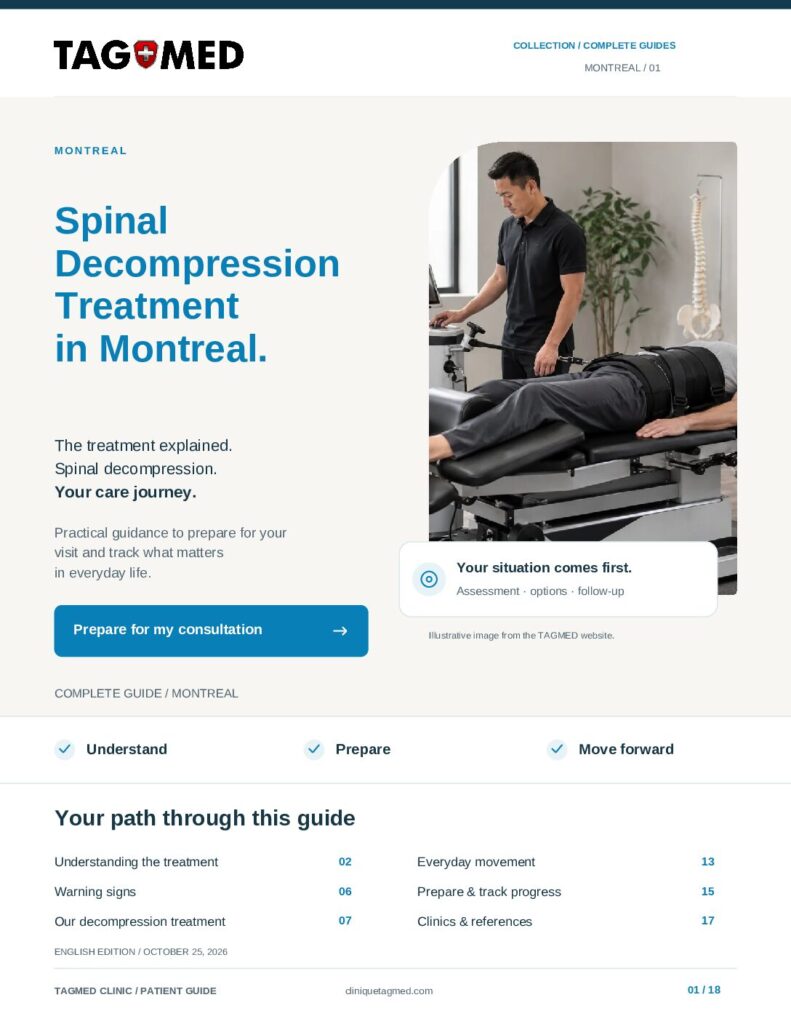
Spinal Decompression Treatment in Montreal.
Your complete guide.
A complete guide to understand symptoms, discuss decompression and other options, and prepare for your consultation.
- The topic and assessment
- Decompression, its limitations and follow-up
- Frequently asked questions and practical worksheets
OUR OTHER CARE PATHWAYS
Resources to continue reading
LEARN MORE
References and practical information
- NICE. NG59: Low back pain and sciatica, recommendations.
- NIAMS. Back Pain: Diagnosis, Treatment, and Steps to Take.
- NHS. Slipped disc.
- NHS. Cervical spondylosis.
- Royal Free London NHS. Degenerative cervical myelopathy.
- Thackeray et al. (2016). Mechanical traction in low back and leg pain. Randomized trial, JOSPT.
- Fritz et al. (2014). Exercise and mechanical traction for cervical radiculopathy. Randomized trial, JOSPT.
- Young et al. (2009). Manual therapy, exercise, and traction for cervical radiculopathy. Randomized trial.
- Pivotal Health Solutions — DOC Decompression Table User Manual
- Pivotal Health Solutions — DOC Decompression Table
- Clinique TAGMED — Spinal decompression
Sources consulted on October 25, 2026. General information: this content does not replace an individual assessment or medical advice.
Clinique TAGMED · Montreal