

TAGMED Clinic | Specialized Osteopathy and Advanced Technologies
Root contact: why simple contact can cause real pain
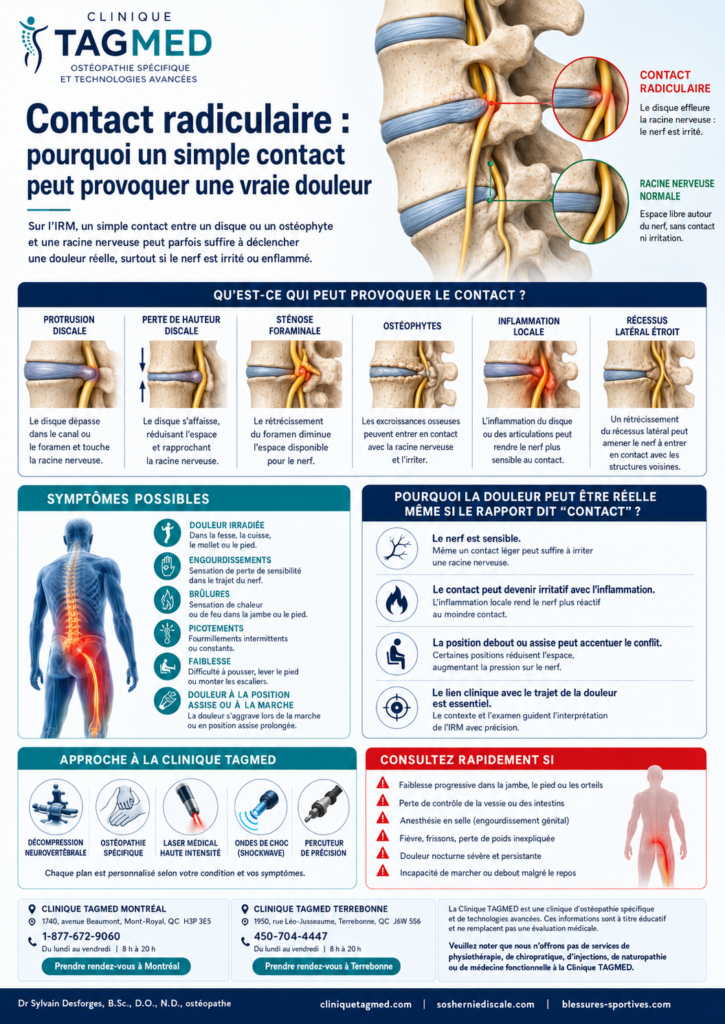
On an MRI report, the expression "root contact" may seem reassuring. However, when a nerve root is already irritated, inflamed, or compressed in a small space, simple contact can be enough to trigger significant, sometimes debilitating, pain.
Many patients arrive at the TAGMED Clinic with a phrase that comes up frequently: "I was told it was just nerve contact." This phrasing can give the impression that the problem is minor, almost insignificant. However, for a patient experiencing sharp pain in their leg, a burning sensation in their calf, tingling in their foot, pain in their arm, or difficulty sitting, the word "contact" doesn't always reflect the reality of their suffering.
A nerve root is not simply a passive cable. It is a living, sensitive, vascularized biological structure surrounded by tissues that can become inflamed. When a disc, a protrusion, If an osteophyte, foraminal stenosis, or narrow lateral recess comes into contact with this root, the nerve can become hypersensitive. It can then send a pain signal to a distant area of the body.
Understanding MRI vocabulary
What does "root contact" actually mean?
The word "radicular" comes from "root." In the spinal column, nerves exit the spinal cord or spinal canal through nerve roots. These roots then leave the spine through small anatomical passages and extend into the arms or legs. When an MRI report mentions a radicular contact, it means that a structure is approaching or making contact with a nerve root.
This structure can be a bulging disc, a disc protrusion, a herniated disc, an osteophyte, a hypertrophied facet joint, a thickened ligament, or a combination of several elements. The report may use different formulations: "contact with the root," "touches the root," "comes into contact with the root," "possible impingement," "root contact without overt compression," or "contact with the emerging root.".
For many patients, these words are difficult to interpret. The term "contact" seems less serious than "compression." Yet, a nerve root can be painful before it is severely compressed. The pain depends on several factors: local inflammation, nerve sensitivity, duration of the problem, available space, repetitive movements, posture, stenosis foraminal associated and overall tolerance of the nervous system.
The key point
The absence of "severe compression" does not mean that the nerve cannot be painful. Simple nerve root contact can become significant if the nerve is inflamed, hypersensitive, or if the affected level corresponds to the exact path of the patient's pain.
Nervous system
Why can simple contact cause so much pain?
To understand radicular pain, we must move beyond the simplistic idea that only severe compression can cause pain. A nerve can be compared to an electrical and biological structure simultaneously. It transmits signals, but it also reacts to its chemical, mechanical, and inflammatory environment.
A healthy nerve root can sometimes tolerate light contact without symptoms. Conversely, an already irritated root can react disproportionately. It's a bit like sunburned skin: light contact can become painful, not because the pressure is strong, but because the tissue is sensitized. The same principle can be applied to an inflamed nerve root.
In a herniated or protruding disc, the disc doesn't just cause mechanical pressure. It can also cause chemical irritation. Disc material and local inflammation can make the nerve root more reactive. Thus, a touch that appeared "light" on the image may be felt as real pain in everyday life.
Local inflammation
The nerve root can become more sensitive when inflammatory mediators irritate the tissues around the disc or foramen.
Lack of space
Foraminal stenosis, a loss of disc height or a narrow lateral recess can make the nerve vulnerable to the slightest contact.
Repeated movements
Sitting, bending, rotating, or walking can transform intermittent contact into repeated irritation.
Nerve sensitization
The longer the pain persists, the more reactive the nervous system can become, even to modest stresses.
Precise route
If the contact is located at the level of a root that corresponds exactly to the pain, it becomes much more relevant.
Cumulative effect
Disc contact, osteoarthritis, and loss of height can act together, even if each element appears moderate.
Common confusion
Why is the patient sometimes told that it's "not serious"?«
A family doctor, emergency physician, or other professional may read a report and conclude that there is no severe compression, no fracture, no tumor, and no surgical emergency. This interpretation may be correct from a medical emergency standpoint, but it does not necessarily mean that the patient's pain is nonexistent, trivial, or psychological.
The confusion often arises from the fact that the imaging report is written in descriptive language. It describes what the image shows, but it cannot always definitively state whether the abnormality is painful. Clinical evaluation is necessary to establish the link between the image, the affected side, the path of the pain, numbness, weakness, aggravating positions, and the progression of the problem.
A report may mention "root contact" without using alarming language. However, if the patient presents with pain that radiates precisely down the territory of that root, if the pain increases in certain positions, or if it is accompanied by burning or tingling sensations, this contact warrants serious attention.
A more complete reading
The question is not simply: "Does the report state severe compression?" The real question is: "Does the described contact correspond to the nerve that explains the patient's pain?"«
Symptoms
What symptoms can be related to root contact?
Symptoms vary depending on which nerve root is affected. In the lumbar region, the pain may radiate down the buttock, thigh, calf, foot, or toes. In the cervical region, it may radiate down the shoulder, arm, forearm, hand, or certain fingers. In some cases, the pain is accompanied by numbness, tingling, burning, or a feeling of weakness.
The patient may notice that the pain increases when sitting, driving, walking, bending over, coughing, sneezing, or turning their neck. These variations provide clues about the mechanical nature of the problem.
Radiating pain
Pain that travels down the leg or arm along a more or less precise path.
Numbness
A sensation of loss of sensation in a nerve area.
Burns
Sensation of fire, heat, electric current, or neuropathic pain.
Tingling
Intermittent or constant tingling in the limb.
Positional pain
Pain worsens when sitting, standing, walking or bending.
Weakness
Difficulty pushing, pulling, lifting the foot, climbing stairs or using the hand.
TAGMED Approach
An assessment focused on the link between the image and the symptoms
At TAGMED Clinic, the goal is not simply to address a single word in a report. The goal is to understand whether the nerve root contact truly corresponds to the pain pathway, the affected side, the neurological symptoms, and the functional limitations. This analysis allows for a better differentiation between disc-related, facet joint, foraminal, muscular, or mixed pain.
When the clinical picture suggests a disc or nerve component, a non-surgical plan may include the Spinal decompression therapy, Specific osteopathic treatments, class IV medical laser therapy, shockwave therapy, or precision percussion are used, depending on the patient's condition and contraindications. The goal is to reduce mechanical stress, soothe local irritation, and improve functional tolerance.
This approach does not promise an automatic cure. Rather, it aims to understand the dominant mechanism and adapt the treatment plan according to the patient's response. Two patients may have similar nerve root contact on MRI, but very different pain depending on their inflammation, posture, occupation, duration of symptoms, and nerve sensitivity.
Clinical objective
Relate the imaging report to the patient's reality: pain, path, aggravating positions, neurological symptoms, available imaging and treatments already tried.
Warning signs
When should you seek medical help quickly?
Radicular pain can be very intense without being a medical emergency. However, certain signs should be evaluated promptly by a doctor or emergency services. Progressive weakness, loss of urinary or fecal control, saddle anesthesia, fever, significant trauma, severe nighttime pain, or loss of walking ability should be taken seriously.
The TAGMED Clinic does not replace medical follow-up. Our role is to assess the biomechanical component and determine if a non-surgical, non-invasive, and personalized approach may be appropriate once signs of emergency have been ruled out.
FAQ
Frequently asked questions about root canal treatment
Can simple root contact really cause pain?
Yes. Contact can be painful if the nerve is inflamed, hypersensitive, or located in an already confined space. The pain depends on the context, not just the word used in the report.
Is this the same as nerve compression?
Not always. Compression generally involves more pronounced pressure, while contact can be lighter. However, contact can still be symptomatic if the nerve is irritated.
Why does the pain go down the leg or arm?
Because each nerve root corresponds to a specific area. Irritation in the spine can therefore be felt far from the spine, in a limb.
Could the report underestimate my pain?
The report describes the image. It does not directly measure pain, inflammation, or nerve sensitivity. This is why clinical evaluation is essential.
Can neurovertebral decompression be considered?
It can be considered when the clinical picture suggests a disc or nerve component that could benefit from a reduction in mechanical stress. Each case must be evaluated individually.
Does your report mention root contact?
An evaluation at the TAGMED Clinic can help to better understand the link between your MRI report, your symptoms, your radiating pain and your spinal mechanics.
Our clinics
TAGMED Clinic Montreal and Terrebonne
Clinical TAGMED Montreal
1140 avenue Beaumont, Mont-Royal, QC, H3P 3E5
Phone : 1-877-672-9060
Days: Tuesday and Thursday
TAGMED Clinic Terrebonne
1150 rue Levis, suite 200, Terrebonne, QC, J6W 5S6
Phone : 450-704-4447
Days: Monday, Wednesday and Friday
Important note
TAGMED Clinic is a specialized osteopathic clinic using advanced technologies. The information presented on this page is for educational purposes only and does not replace a medical evaluation. In case of severe, new, progressive, or concerning symptoms, consult a doctor or emergency services.
Please note that we do not offer physiotherapy, chiropractic, injections, naturopathy or functional medicine services at the TAGMED Clinic.
Receipts are issued for eligible services depending on the nature of the consultation, particularly in osteopathy, These services may be covered by most private plans, depending on the terms of your insurance contract. They are not covered by RAMQ.


 Français du Canada
  English (Canada)