

TAGMED Clinic | Specialized Osteopathy and Advanced Technologies
Why does your MRI seem reassuring even though your pain is severe?
It frequently happens that a patient experiences intense, persistent, or debilitating pain, while their MRI report uses terms like "mild," "moderate," "slight," or "without severe compression." This apparent contradiction is one of the greatest sources of frustration for patients suffering from lower back, neck, sciatic, or radicular pain.
Many patients seek medical help after receiving an imaging report that doesn't seem to reflect their true suffering. They experience pain when sitting, they can no longer tolerate car rides, they feel a burning sensation in their leg, pain in their arm, numbness in their foot or hand, or pain that returns as soon as they resume their activities. Yet, they are sometimes told that the MRI shows "nothing serious.".
This situation does not mean that the pain is imaginary. Nor does it mean that the MRI is useless. Rather, it means that the image and the pain do not always tell the same story in the same way. The MRI describes structures. It shows the disc, the vertebrae, the spinal canal, the foramina, the facet joints, and sometimes the nerve roots. But it does not directly measure inflammation, nerve sensitivity, tolerance to sitting, pain when walking, or the functional impact on daily life.
Understanding this nuance is essential. An MRI may seem reassuring from an urgent medical point of view, while showing biomechanical elements capable of explaining real pain: disc protrusion, annular fissure, foraminal stenosis, root contact, narrowed lateral recess, degenerative disc disease, facet joint osteoarthritis or disc-osteophyte complex.
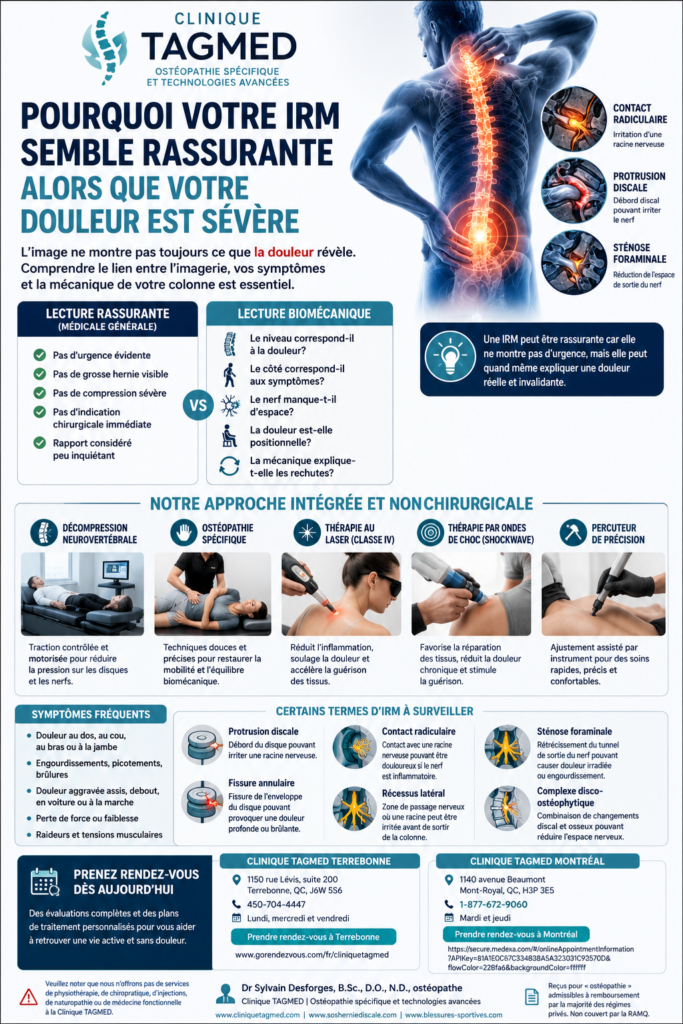
Understanding the gap between image and pain
Why a "reassuring" MRI can still be compatible with significant pain
An MRI is a very useful imaging examination. It allows visualization of the intervertebral discs, nerve roots, spinal canal, facet joints, ligaments, and certain bony structures. It can help identify a herniated disc, a protrusion, foraminal stenosis, spinal stenosis, discopathy, osteoarthritis, or nerve root compression.
However, an MRI scan captures an image at a specific moment, usually while the patient is lying down. Yet, a patient's pain often occurs in real-life situations: sitting in a car, standing at work, bending over to pick up an object, walking, climbing stairs, sleeping in certain positions, or after a day of activity. Therefore, the mechanical context is not always identical to that of the image.
Furthermore, an MRI report often uses cautious terminology. The words "mild," "moderate," or "subtle" describe an anatomical appearance. They do not necessarily describe the intensity of the pain. A small protrusion located in precisely the wrong place can irritate a nerve root. Moderate foraminal stenosis can be very painful if the nerve is inflamed. An annular tear can cause burning without a large herniation. Facet joint osteoarthritis can cause local or referred pain even if the disc is not extensively affected.
The key point
An MRI can be reassuring because it doesn't show any emergency, tumor, fracture, or severe compression. This doesn't mean it doesn't show anything that could explain real pain.
Medical reading vs. biomechanical reading
«"Nothing serious" does not always mean "nothing painful".»
When a professional says an MRI shows "nothing serious," they often mean there is no medical or surgical emergency. This can mean there is no major spinal cord compression, no fracture, no tumor, no apparent infection, and no severe neurological syndrome requiring immediate intervention. This information is important and reassuring.
However, for the patient, this phrase can be interpreted differently. They might understand it as: "You shouldn't be in pain." This is where the confusion begins. A condition may not be urgent but still be very painful. A herniated disc, an annular fissure, a foraminal stenosis, nerve root irritation, or facet joint osteoarthritis can have a major impact on quality of life without necessarily being considered an emergency.
The general medical reading first seeks to rule out serious problems. The biomechanical reading then seeks to understand why the patient is in pain, which structures appear to be involved, and What mechanism maintains the pain?. These two interpretations are not contradictory. They are complementary.
A family physician does their best in a vast field: prevention, infections, hypertension, diabetes, mental health, medications, emergencies, pediatrics, geriatrics, and overall care. It is difficult for them to specialize in all the intricacies of radiological terminology related to the spine. This is why certain terms like "root contact," "annular fissure," "disco-osteophyte complex," or "lateral recess" may be underestimated in their functional impact.
Reassuring reading
- No obvious emergency.
- No large hernia visible.
- No severe compression was described.
- No immediate surgical indication.
- The report was considered not very worrying.
Biomechanical reading
- Does the level correspond to the pain?
- Does the side correspond to the symptoms?
- Is the nerve lacking space?
- Is the pain positional?
- Does mechanics explain relapses?
Pain and inflammation
Why pain is not always proportional to the size of the abnormality
Many patients believe that the larger the anomaly, the more intense the pain should be. This logic seems intuitive, but it is often too simplistic. A large central herniated disc can sometimes be relatively well tolerated if it does not impinge on a sensitive nerve root. Conversely, a small foraminal protrusion can be extremely painful if it is located directly at the nerve's exit point.
Pain depends on several variables: the location of the abnormality, the presence of inflammation, nerve root sensitivity, the degree of stenosis, the duration of symptoms, aggravating positions, the condition of the disc, the condition of the facet joints, and the patient's overall tolerance. The size of the abnormality is one factor among others, but it is not sufficient to explain all the pain.
Inflammation plays a major role. An inflamed nerve root can become hypersensitive. Even light touch can then cause sharp pain. An annular fissure can produce burning pain without dramatic disc displacement. Active facet joint osteoarthritis can cause intense local pain even if it is described as moderate.
Duration also matters. Pain that has been present for several months can sensitize the nervous system. The patient becomes more reactive to positions, movements, and loads. They may experience pain that is disproportionate to the words in the report, not because they are exaggerating, but because the tissues and nervous system have become irritable.
Common example
A small protrusion in the wrong place can cause more pain than a more visible abnormality that doesn't affect any sensitive structures. Location and inflammation are often more important than size alone.
Words to watch out for in your report
Terms that can explain pain despite an apparently moderate MRI
When a patient reads their report, they often look for the term "herniated disc." However, several other terms can be important. Some words describe the disc, others describe the space around the nerve, and still others describe the joints or bony structures. A thorough reading should consider the entire report.
A report may not contain the word "hernia" while still describing a disc protrusion, foraminal stenosis, An annular fissure or root contact. These elements can be clinically relevant if the symptoms correspond to the level and side described. The problem, therefore, is not only what is written, but how it is interpreted in the patient's actual context.
Disc Protrusion
Disc protrusion or displacement that can irritate a nerve root depending on its location.
Annular crack
A fissure in the disc membrane can cause deep or burning pain.
Root contact
Contact with a nerve root can be painful if the nerve is inflamed.
Foraminal stenosis
Narrowing of the nerve exit tunnel can cause radiating pain or numbness.
Lateral recess
Area of nerve passage where a root can be irritated before exiting the column.
Disco-osteophyte complex
A combination of disc and bone changes can reduce nerve space.
MRI lying down vs. actual pain
Why your pain may be worse when standing, sitting, or moving
An MRI scan is usually performed with the patient lying down. This position reduces certain mechanical stresses. The patient does not bear their weight in the same way as when standing. They do not walk. They do not bend over. They do not drive. They do not remain seated for 45 minutes. They do not necessarily reproduce the position that triggers their pain.
However, many types of spinal pain are dynamic. Foraminal stenosis can become more symptomatic when extending or standing. An annular fissure can be more painful when sitting or flexing. Facet joint pain can increase with extension or rotation. Radicular irritation can be aggravated by certain positions of the pelvis, neck, or spine.
This explains why a report may appear unremarkable, but the patient cannot tolerate their daily life. A static image does not always show the effect of load, posture, muscle fatigue, repetitive micromovements, or fluctuating inflammation.
A good assessment should therefore include very specific questions: How long can you sit for? What happens in the car? Does walking relieve or worsen the pain? Does the pain radiate down a limb? Do the symptoms change depending on the position of the neck or back? These answers guide the interpretation of the imaging.
Patient validation
Your pain is real even if the report seems "not so bad".«
One of the most difficult aspects for patients is the feeling of not being believed. When the report lacks impressive wording, some patients are told that their pain should go away, that it's not serious, or that they simply have to live with it. Yet, the pain can be real, debilitating, and consistent with subtle elements of the report.
Spinal pain is not simply a visual representation. It results from an interaction between structures, inflammation, mechanics, the nervous system, activity, posture, and time. One patient may have a moderate but poorly tolerated abnormality. Another may have a more visible abnormality with few symptoms. This variability is normal.
The role of a thorough assessment is therefore not to invalidate the patient, but also not to dramatize unnecessarily. It is necessary to listen to the symptoms, link the image to the path of the pain, identify aggravating factors, rule out signs of emergency, and propose a logical strategy.
Avoid two mistakes
We shouldn't conclude that everything stems from the MRI, nor should we conclude that the pain is without cause simply because the MRI appears moderate. Clinical truth often lies in the interplay between the image, the symptoms, and the underlying mechanics.
TAGMED Approach
Relate your MRI report to your actual pain
At the TAGMED Clinic, the assessment aims to understand why seemingly reassuring imaging can still correspond to significant pain. We analyze the terms of the report, the level reached, the side of the symptoms, the pain pathway, tolerance to positions, treatments already tried, and how the pain evolves over time.
The goal is not to treat a single word, but a mechanism. A foraminal protrusion is not treated the same as an annular fissure. Facet joint osteoarthritis is not treated as pure disc pain. Lateral recess stenosis is not the same as central stenosis. Neck pain radiating into the arm is not exactly understood as lower back pain radiating down the leg.
When the assessment suggests a disc, foraminal, or nerve component, the Spinal decompression therapy This can be considered a non-surgical and non-invasive approach to reducing certain mechanical stresses on the discs and nerve structures. Depending on the context, specific osteopathic techniques, Class IV medical lasers, shockwave therapy, or precision percussion can also be integrated into a personalized plan.
This approach does not promise an automatic cure. Rather, it aims to better understand the probable cause of the pain, reduce irritating mechanical factors, improve functional tolerance, and prevent the patient from being caught between two frustrating phrases: "your MRI isn't that serious" and "yet you're in a lot of pain.".
Clinical objective
Transforming a vague reading of the report into useful understanding: what level, what side, what nerve, what structure, what position, what mechanism and what personalized care plan.
When to consult
When can an evaluation be relevant?
An evaluation may be relevant when your pain is significant but your report seems moderate, especially if you have radiating symptoms, a pain that goes down the leg, intolerance to sitting, pain when walking, numbness, burning or frequent relapses.
It can also be helpful if you've tried several approaches without lasting relief, or if you feel your MRI report wasn't explained clearly. Many patients don't need to be scared; they need to have the words explained to them, explaining what they actually mean and how they relate to their pain.
Severe pain
Significant pain despite a report described as mild or moderate.
Irradiated symptoms
Pain that goes down the leg, arm, hand or foot.
Numbness
Tingling, burning or loss of sensation in a nerve area.
Positional pain
Pain worsens when sitting, standing, in a car, bending or walking.
Relapses
Temporary improvements followed by a rapid return of pain.
Report misunderstood
Terms such as protrusion, fissure, stenosis, root contact or osteoarthritis are not explained.
Caution
When should you consult a doctor quickly?
Certain situations require prompt or urgent medical evaluation. Progressive weakness in an arm or leg, loss of urinary or fecal control, saddle anesthesia, fever, unexplained weight loss, severe nighttime pain, significant trauma, or an inability to walk should be taken seriously.
A reassuring MRI should never replace attention to warning signs. A non-surgical and non-invasive approach can only be considered when signs of emergency have been ruled out and the assessment suggests that the condition can be managed safely.
FAQ
Frequently Asked Questions
Why am I in so much pain if my MRI is only "moderate"?
Because pain depends on location, inflammation, nerve sensitivity, posture, and the relationship between the abnormality and your symptoms. The word "moderate" does not directly measure your pain.
Can a small protrusion cause a lot of pain?
Yes. A small protrusion located near a sensitive nerve root can cause significant pain, especially if there is associated inflammation or stenosis.
Why doesn't the MRI show my pain?
MRI shows structures, but it does not directly measure pain, tolerance to sitting, active inflammation, or nervous system sensitivity.
My doctor told me it wasn't serious. Is that contradictory to my pain?
Not necessarily. It may mean that there is no medical or surgical emergency, but there may still be a painful biomechanical cause.
Can neurovertebral decompression be considered?
It may be considered when the assessment suggests a disc, foraminal, or nerve component that could benefit from a reduction in mechanical stress. Each case must be evaluated individually.
Should I be worried if my report contains several anomalies?
Not necessarily. Several abnormalities can be common with age. The important thing is to determine which ones actually correspond to your symptoms.
Your MRI seems reassuring, but your pain is severe?
An assessment at the TAGMED Clinic can help you understand the connection between your imaging report, your symptoms, your limitations, and the mechanics of your spine. Our approach aims to clarify what your report truly means in your specific situation.
Our clinics
TAGMED Clinic Montreal and Terrebonne
Clinical TAGMED Montreal
1140 avenue Beaumont, Mont-Royal, QC, H3P 3E5
Phone : 1-877-672-9060
Days: Tuesday and Thursday
TAGMED Clinic Terrebonne
1150 rue Levis, suite 200, Terrebonne, QC, J6W 5S6
Phone : 450-704-4447
Days: Monday, Wednesday and Friday
Important note
TAGMED Clinic is a specialized osteopathic clinic using advanced technologies. The information presented on this page is for educational purposes only and does not replace a medical evaluation. In case of severe, new, progressive, or concerning symptoms, consult a doctor or emergency services.
Please note that we do not offer physiotherapy, chiropractic, injections, naturopathy or functional medicine services at the TAGMED Clinic.
Receipts are issued for eligible services depending on the nature of the consultation, particularly in osteopathy, and may be submitted to most private plans according to the terms of your insurance contract. These services are not covered by RAMQ.


 Français du Canada
  English (Canada)