TAGMED Clinic Montreal / Mount Royal
Sciatica on the top of the foot: when to consider the L5 nerve root
Understand the nerve distribution, motor and sensory signs and the limitations of L4-L5-S1 maps.
Pain, burning or numbness on top of the foot may be consistent with L5 radiculopathy, but this area is also supplied by peripheral nerves. The full leg pain pattern and foot strength assist in locating the problem more precisely.
- Related page in this guide series Sciatica treatment in Montreal.
- Dermatomes and myotomes provide reference points, but their distribution varies between individuals.
- Progressive weakness, foot drop or signs of cauda equina syndrome change the priority of assessment.

Understanding
What this symptom pattern may mean
Pain, burning or numbness on top of the foot may be consistent with L5 radiculopathy, but this area is also supplied by peripheral nerves. The full leg pain pattern and foot strength assist in locating the problem more precisely.
Distribution
The top of the foot is frequently associated with the L5 sensory distribution.
Function
A fibular nerve condition can produce very similar symptoms without a lumbar origin.
Differential diagnosis
Dorsiflexion and big toe extension assist in completing the assessment.
Clinical guidance
The top of the foot alone does not locate the lesion
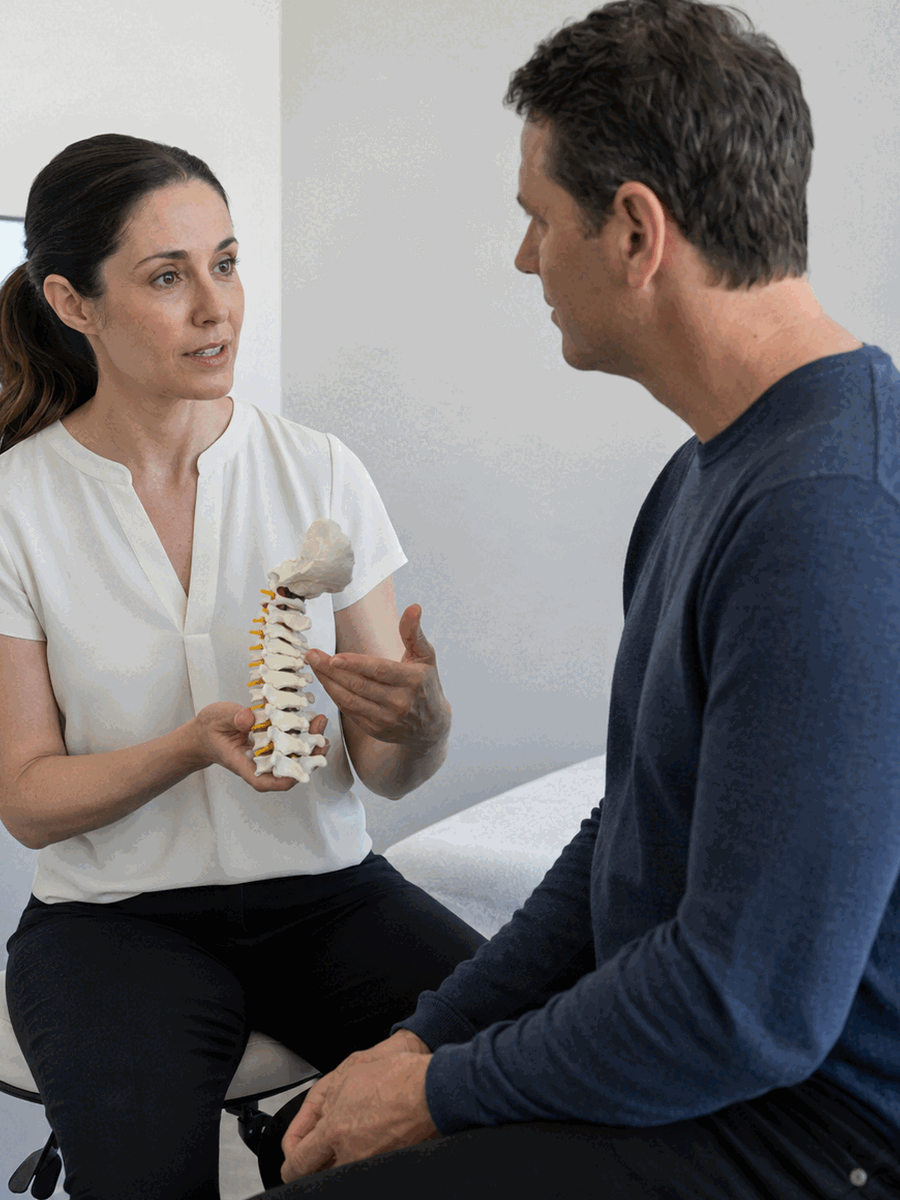
Peripheral nerves and nerve roots have overlapping distributions. An isolated numb area must be interpreted alongside strength, reflexes, the proximal symptom pattern and triggering factors.
An important point
Compression of the fibular nerve near the knee can mimic L5. The distinction changes the care strategy.
Assessment
What can be assessed during a consultation
The examination compares sensation on top of the foot, dorsiflexion, toe extension, heel walking and the symptom pattern from the lower back or buttock.

Route
Precisely locate pain, tingling and areas of numbness.
Force
Compare movements corresponding to the relevant myotomes and their effect on walking.
Reflexes and sensation
Add neurological findings without treating a single test as definitive.
Imaging when relevant
Correlate MRI findings with the level, side and clinical presentation when they may change management.
Options and limitations
Adapt care to the likely cause
Management depends on the most likely location. Lumbar decompression is relevant only if the overall clinical picture truly supports a lumbar origin.
Conservative approach
Adapted activity, gradual progression, rehabilitation and neurological follow-up according to the clinical profile.
Spinal decompression therapy
May be discussed for selected patients when a matching disc-related or foraminal component is identified.
Further referral
Further investigation, an injection or specialist advice may be relevant depending on severity, duration and progression of the deficit.
When should you seek prompt or emergency care?
- New, significant or rapidly progressive weakness.
- Recent foot drop or worsening walking ability.
- New bladder or bowel problems.
- Numbness in the saddle area or perineum.
- Significant bilateral symptoms or rapid neurological deterioration.
These signs should not wait for a routine appointment.
Follow-up
Measure neurological and functional progress
Follow-up compares pain, the area of numbness, strength, walking and activities. Objective deterioration should lead to reassessment of the diagnosis and plan.

Do you have pain or numbness on top of your foot?
A consultation can assist in identifying the nerve distribution, likely cause, signs to watch for and relevance of the different care options.
Spinal decompression in Montreal · Spinal decompression in Terrebonne
Sciatica treatment in Montreal · Sciatica treatment in Terrebonne
Frequently Asked Questions
FAQ — Sciatica on top of the foot: when to consider the L5 nerve root
Does the top of the foot always correspond to L5?
No. The fibular nerve can produce similar symptoms.
Is the big toe linked to L5?
It is frequently included in the clinical distributions associated with L5.
Can pain without back pain come from L5?
Yes, radiculopathy can sometimes present mainly in the leg or foot.
Why test heel walking?
It requires dorsiflexion and may reveal weakness.
Can a tight shoe mimic a nerve problem?
Yes, local compression or a foot problem can cause sensory symptoms.
When does MRI become useful?
When a lumbar origin is likely and the result may change management.
When should you seek prompt care?
If the foot becomes weak, catches on the ground or numbness progresses rapidly.
Medical references
References and guidelines
Ces références servent de repères généraux pour la sciatique, la radiculopathie lombaire et l’imagerie. Les cartes de dermatomes et myotomes comportent des variations cliniques et ne doivent pas être utilisées seules pour poser un diagnostic.
- NICE NG59 — Low back pain and sciatica: assessment and management
- American College of Radiology — Appropriateness Criteria: Low Back Pain
- NCBI Bookshelf — Radicular Back Pain
Important information
Cette page fournit de l’information générale et ne pose pas de diagnostic. Les symptômes L4, L5 et S1 peuvent se chevaucher. Une faiblesse ou une détérioration neurologique doit être évaluée selon son importance et sa progression.
Sylvain Desforges, docteur en ostéopathie
TAGMED Clinic — Spinal decompression, specific osteopathy and assessment of low back, disc-related and sciatic pain.
Professional profile · Contact · Main guide to sciatica in Montreal
In the same guide series
Related guides to sciatica
Continue with guides that explore the same symptom, its possible cause, assessment or options for care.
Sciatica treatment in Montreal
Clinique TAGMED Montréal / Mont-Royal Traitement de la sciatique à Montréal Examen gratuit — valeur de 85 $ CADemander mon examen gratuitVoir les disponibilitésDemandez…

Sciatica along the outer edge of the foot: when the S1 nerve root is suspected
TAGMED Clinic Montreal / Mount Royal — Sciatica along the outer edge of the foot: when the S1 nerve root is suspected. Understanding the nerve distribution, the signs…

Sciatica or tarsal tunnel syndrome: burning under the foot or nerve root irritation?
TAGMED Clinic Montreal / Mount Royal — Sciatica or tarsal tunnel syndrome: burning under the foot or nerve root irritation? Comparing the distribution, the…

Pain from the buttock to the foot: is it sciatica?
Clinique TAGMED Montréal / Mont-Royal Douleur de la fesse jusqu’au pied : est-ce une sciatique? Rendez-vous dans nos deux cliniques Montréal / Mont-Royal Mardi…

L5-S1 herniated disc and sciatica: calf, heel and foot pain
TAGMED Clinic Montreal / Mount Royal — L5-S1 herniated disc and sciatica: calf, heel and foot pain. Understanding the connection between a herniated disc,…

Sciatica in the heel or sole of the foot: distinguishing S1 from a local problem
TAGMED Clinic Montreal / Mount Royal — Sciatica in the heel or sole of the foot: distinguishing S1 from a local problem. Understanding the nerve distribution,…