TAGMED Clinic · Montreal · Town of Mount Royal · Terrebonne
Sciatica: symptoms, causes and non-surgical treatments
Vous habitez Mascouche? Organisez votre examen pour une douleur sciatique à Terrebonne. Examen gratuit, valeur de 85 $ CA.
Understand pain that travels into the buttock, leg or foot, and identify its underlying cause before choosing a treatment.
Sciatica is a neurological condition attracting growing interest in the medical field because of its high incidence and significant impact on quality of life. It is characterized by intense pain that radiates along the sciatic nerve, the largest nerve in the human body. The sciatic nerve originates in the lumbar region of the spine and extends down into the legs.
It is crucial to understand that sciatica is not a diagnosis in itself, but rather a symptom of an underlying problem that requires a thorough medical evaluation for an accurate diagnosis. Identifying the exact cause is essential to developing an effective treatment plan, which may range from osteopathy to injections and include non-invasive methods such as spinal decompression.
- Assessment of lower back pain radiating into the buttock, leg or foot.
- Review of possible causes: herniated disc, disc protrusion, stenosis, osteoarthritis or nerve irritation.
- Spinal decompression when appropriate for the condition.
- Clinic located in the Town of Mount Royal near Montreal, with a service location in Terrebonne.

Sciatica: consultations in Montreal or Terrebonne
Looking for a consultation for sciatica? Read about treatment and spinal decompression at the clinic of your choice.
Montréal / Mont-Royal
- Herniated disc treatment in Montreal
- Sciatica treatment in Montreal
- Tuesday and Thursday, 9 a.m. to 6 p.m.
Terrebonne
- Herniated disc treatment in Terrebonne
- Sciatica treatment in Terrebonne
- Monday and Wednesday, 8 a.m. to 6 p.m.
Clinical information
Reviewed content and purpose of this page
This page provides a structured overview of sciatica: symptoms, the course of the sciatic nerve, possible causes, diagnosis, signs to watch for, and conservative options when appropriate.
Clinical review
Clinical content reviewed by Sylvain Desforges, B.Sc., D.O., N.D., Doctor of Osteopathy. TAGMED Clinic Montreal / Town of Mount Royal and Terrebonne. Last updated: June 2026.
This page is provided for educational purposes and does not replace a medical consultation, neurological assessment, or urgent care when warning signs are present.
Quick navigation
Table of contents
Go directly to the main sections of this page about sciatica.
Symptoms
Recognize pain, numbness, tingling or weakness associated with sciatica.
Causes
Understand possible causes: herniated disc, disc protrusion, stenosis, osteoarthritis or piriformis syndrome.
Diagnosis
See how clinical assessment, a neurological examination and imaging can guide the assessment.
Treatment
Explore conservative options, including spinal decompression when appropriate for the condition.
When to seek prompt care
Identify neurological or medical signs that require prompt assessment.
FAQ
Read frequently asked questions about sciatica, its causes, symptoms and treatments.
Who is this for?
Who is this page about sciatica for?
This page is for people who experience pain in the lower back, buttock, thigh, calf or foot, especially when the pain is accompanied by burning, tingling,
numbness or weakness. It explains possible causes and situations in which a clinical assessment becomes important.
Understanding sciatica
What is sciatica?
Sciatica describes symptoms of pain that originate in the lower back and radiate to the back of the leg. This is not a diagnosis in itself but rather a symptom of an underlying problem in the lower back, such as a herniated disc, disc bulging, degenerative disc disease, spondylolisthesis or spinal stenosis.
Sciatica usually accompanies lower back pain, but it can be more severe and can occur on its own. Pain in the hip or knee therefore does not necessarily mean that a condition is causing pain at that location: it may actually result from pinching or irritation of the sciatic nerve, causing pain to radiate far from its point of origin.
The importance of a multidisciplinary approach to treating sciatica cannot be overstated. Because symptoms are complex and multiple factors can contribute to the condition, a comprehensive assessment by experienced health professionals is often necessary.
Key takeaways
Sciatica should be understood as a clinical sign. Treatment should not be chosen solely on the basis of the word “sciatica,” but according to the likely cause of the nerve irritation.
Nerve pathway
What is the sciatic nerve, and what path does it follow?
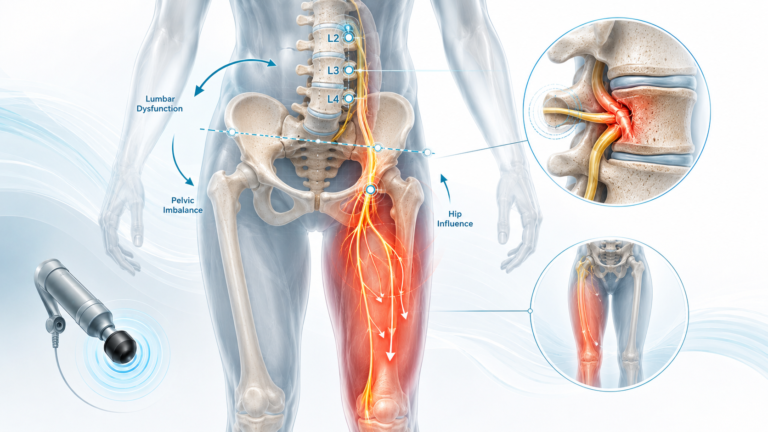
The sciatic nerve is the largest nerve in the body. It is made up of nerve roots that originate in the lumbar region of the spine and join farther down to form the sciatic nerve.
Lumbar origin
Symptoms occur when the sciatic nerve is irritated or compressed at or near its origin, often in the lumbar or lumbosacral region.
Path through the leg
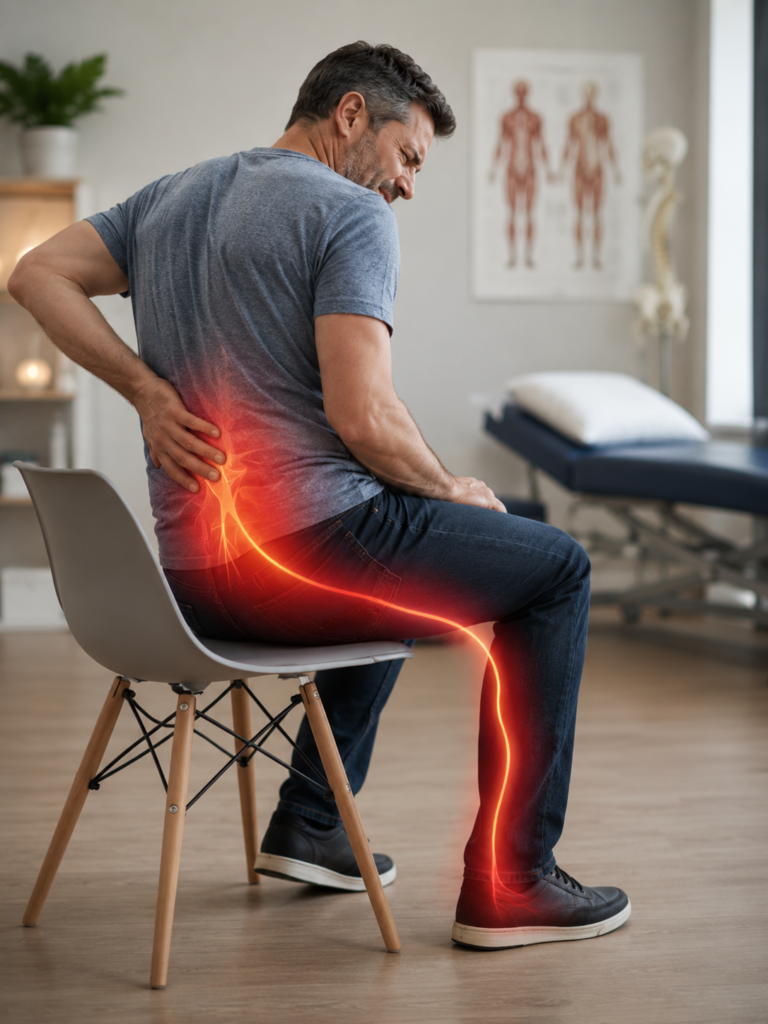
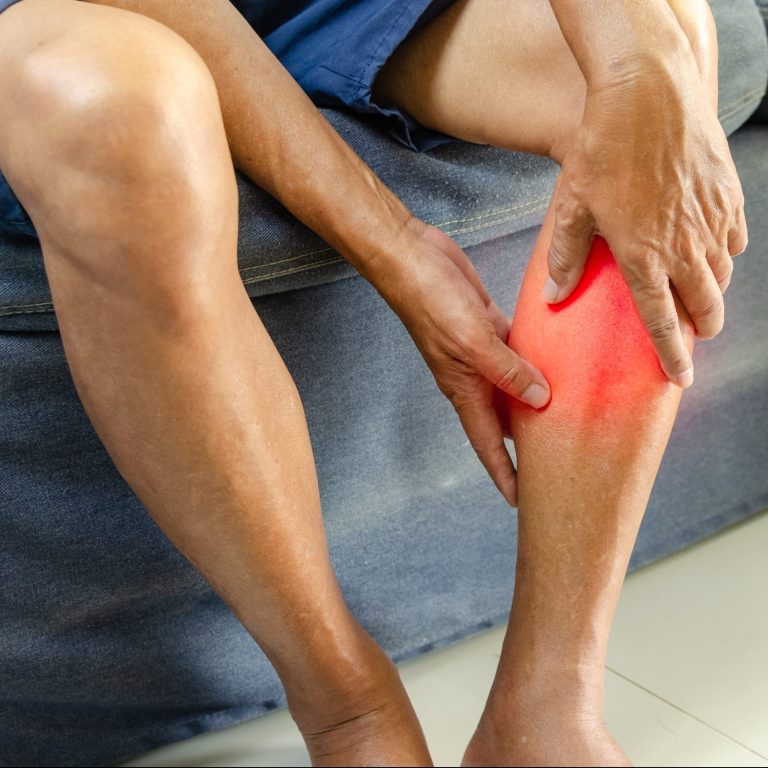
Pain or symptoms may follow the middle of the buttock, the back of the thigh, the calf, the heel, the sole of the foot or the toes.
Symptoms may follow only part of the path
The path may be incomplete: you may feel pain or symptoms along the entire nerve or only part of it, for example only in the calf. This largely depends on how the nerve is pinched or irritated.

Symptoms
What are the symptoms of sciatica?
Symptoms of sciatica include shooting pain in the lower back and legs, numbness and tingling in the lower limbs. The pain can be so intense that standing or walking becomes difficult.
Sharp pain
Sharp pain can make it difficult to stand, walk or tolerate certain positions.
Pain in the buttock or leg
Pain is often constant on only one side of the buttock or leg, and rarely affects both legs except in certain conditions involving more central structures.
Pain when sitting
Prolonged sitting can worsen some symptoms, especially when a disc-related component is involved.
Burning or tingling
Leg pain is often described as burning, tingling, tightness or an electric sensation.
Numbness
A partial loss of sensation may occur in the leg, foot or toes, depending on the nerve root involved.
Possible weakness
Weakness or difficulty moving the leg, foot or toes requires careful assessment, especially if it is progressing.
Leg pain or back problem?
Leg pain can sometimes originate in the lower back, even when there is little lower back pain. Read the page about leg pain.
Variability of symptoms
Sciatic pain can range from occasional and irritating to constant and disabling. Symptoms may affect one side or, less often, both sides.
Functional impact
Muscle weakness and functional limitations
Sciatica can significantly affect quality of life when it limits walking, sitting, climbing stairs, working or sleeping.
Muscle weakness
Muscle weakness associated with sciatica often results from compression or irritation of the sciatic nerve, which can have various causes, including a herniated disc, spinal stenosis or inflammation.
This weakness can range from mild difficulty lifting the foot to a more severe inability to perform certain movements. Progressive weakness should be assessed promptly.
Functional Limitations
Functional limitations may include reduced mobility, difficulty sitting or standing for long periods, and challenges with everyday activities such as walking or climbing stairs.
The main goal of treatment is to reduce pain, improve function and prevent long-term complications.
Important caution
Muscle weakness can be a significant neurological sign. It should not be dismissed, especially when it is new, progressive or associated with significant numbness.
Possible causes
What are the common causes of sciatica?
Common causes of sciatica include a herniated disc, bulging of the disc, spinal stenosis, foraminal stenosis, spondylolisthesis and nerve compression caused by a tight muscle or trauma.
Herniated disc
A herniated disc can irritate or compress a lumbar nerve root, which may cause pain in the buttock, leg or foot.
Disc bulging or protrusion
A bulging disc can reduce the space available around a nerve root and contribute to sciatic nerve irritation.
Disc space narrowing
A loss of disc height can alter lumbar mechanics and narrow some of the spaces around nerves.
Spinal or foraminal stenosis
Narrowing of the spinal canal or a foramen can reduce the space available for nerve roots.
Spondylolisthesis
Vertebral slippage can affect lumbar stability and contribute to nerve irritation.
Syndrome-the piriformis
Irritation of the sciatic nerve in the buttock region can cause pain resembling sciatica that originates in the lower back.

Source of the pain
Disc-related sciatica or pain that mimics sciatica?
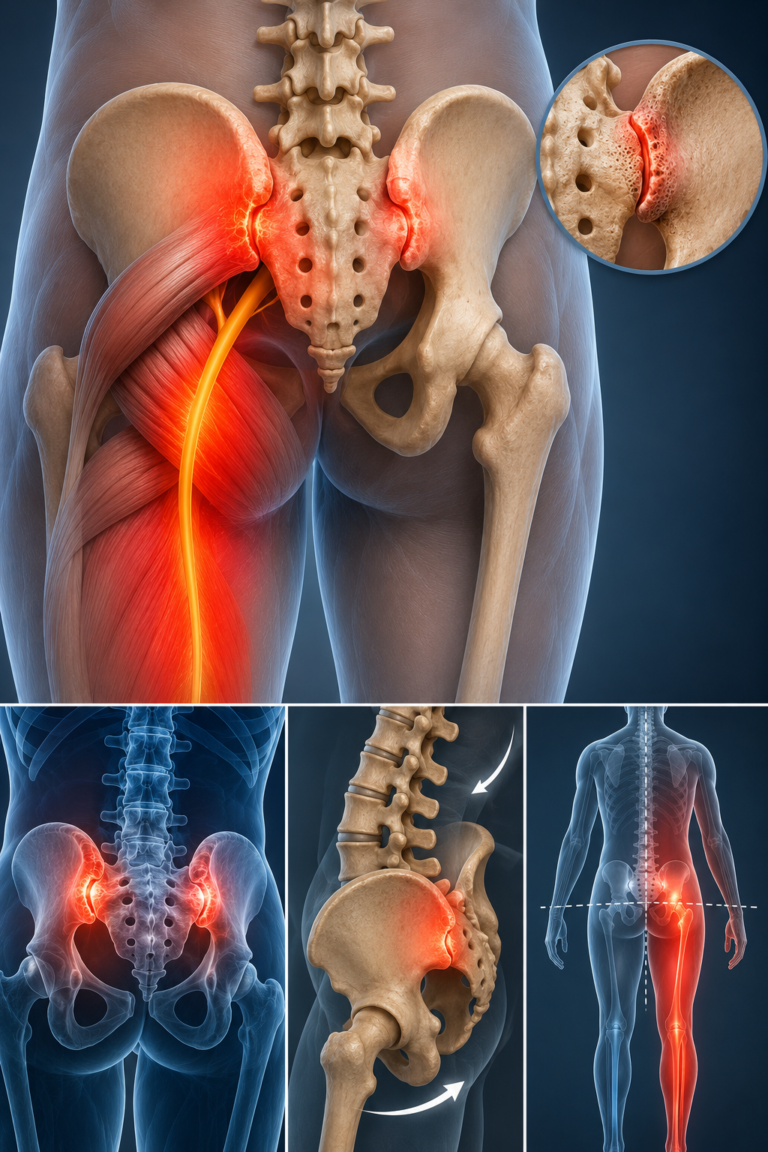
Pain that travels down the leg can originate in a lumbar nerve root, but it can also result from muscle irritation, a hip or pelvic problem, or referred pain.
Disc-related sciatica
Often associated with a herniated disc, disc protrusion or disc-space narrowing that irritates a nerve root.
Sciatica caused by stenosis
May be aggravated by walking or prolonged standing, especially when foraminal or spinal narrowing is present.
Pain that mimics sciatica
Some pain originating in the hip, pelvis or deep muscles can resemble sciatica.
Differential diagnosis
Leg pain is not always sciatica
Pain that travels down the leg can sometimes originate in the hip, pelvis, deep muscles or another nerve root. Treatment should therefore not be based solely on the path of the pain.
Sciatica
Often affects the buttock, the back of the thigh, the calf, the heel, the sole of the foot or the toes. It may be related to a herniated disc, a protrusion or foraminal stenosis.
Cruralgia or referred pain
Cruralgia tends to affect the front of the thigh, groin or knee. Hip, sacroiliac or muscle pain can also mimic sciatic pain.
Why this distinction matters
The assessment aims to distinguish disc-related or nerve-root-related sciatica from pain originating in another structure. This helps guide treatment more effectively and avoid an overly general approach.
Clinical evaluation
Diagnosis of sciatica
The diagnosis of sciatica often involves a physical examination and a complete medical evaluation of the patient's medical history. Imaging tests such as x-ray or MRI may be needed to confirm the diagnosis.
Symptom assessment
The path, duration and intensity of pain, aggravating and relieving factors, and its impact on everyday activities.
Clinical exam
Assessment of lower back pain, pain radiating into the leg, mobility and relevant neurological signs.
Imaging when needed
If an MRI, CT scan or X-ray is available, it can be interpreted alongside the symptoms and examination findings.
Guiding the care plan
When appropriate for the condition, a conservative approach may be proposed. Otherwise, another clinical or medical course of action may be recommended.

Imaging
MRI, X-rays, EMG and mobility tests
Imaging and additional tests can be useful, but they must always be considered alongside the patient’s symptoms, the path of the pain and the findings of the assessment.
MRI
Magnetic resonance imaging is often considered the examination of choice when a herniated disc or spinal stenosis is suspected as the underlying cause. It allows the discs, nerves and soft tissues to be visualized.
X-ray
X-rays can help identify certain bone abnormalities, signs of osteoarthritis, fractures or alignment problems, but they show discs and nerves less clearly.
Electromyogram
EMG measures the electrical activity of muscles in response to nerve stimulation and can help locate nerve damage in certain circumstances.
Tests of mobility
Tests such as the straight-leg raise test (Lasègue’s test), along with assessment of strength, reflexes and sensation, can help confirm nerve irritation.
Important caution
An image should not be interpreted on its own. Several abnormalities visible on imaging may not be the main cause of the pain. Clinical correlation remains essential.
TAGMED Approach
Treatment of sciatica
The Spinal decompression therapy is a non-invasive method that involves gradually and carefully stretching the spine to reduce pressure on nerve endings and intervertebral discs.
The most appropriate treatment for sciatica depends on a comprehensive clinical assessment, which may include imaging tests such as X-rays or MRI, a thorough physical examination and a detailed medical history.
Spinal decompression therapy
This non-invasive technique uses controlled traction forces to reduce certain mechanical stresses on the spinal discs, which may be relevant when the sciatica is consistent with disc or nerve-root involvement.
Osteopathy
In some cases where sciatica is influenced by posture, the pelvis, joint mobility or certain mechanical tensions, an osteopathic approach may be incorporated into the care plan.
Medication or injections
Anti-inflammatory medication, pain medication or injections may sometimes be considered on a physician’s advice, particularly when inflammation or pain is significant.
Surgery
Surgery may be considered in certain severe or persistent cases, or when significant neurological deficits are present. This decision must be made with a medical specialist.
What is the best treatment for sciatica?
There is no single “miracle” treatment for sciatic pain. Several approaches are possible, depending on the cause of the sciatica, the severity of symptoms, neurological signs and how the condition progresses.
Spinal decompression therapy
Treatment of sciatica by decompression neurovertébrale
If sciatica is caused by a disc problem, such as a herniated disc, protrusion, disc bulging, disc-space narrowing or disc desiccation, or by stenosis or spondylolisthesis, spinal decompression may be considered according to the clinical presentation.
Mechanical objective
Spinal decompression applies controlled, progressive traction to the lumbar spine. It aims to reduce certain mechanical stresses on the discs and nerve roots when appropriate for the condition.
Assessment before treatment
The aim is to determine whether the pain follows a nerve-root distribution, whether symptoms correspond to imaging findings and whether any contraindication makes the approach inappropriate.
Significant neurological symptoms
If neurological symptoms become too severe, such as an almost complete loss of sensation or mobility in the leg, these signs must not be ignored and urgent medical attention should be sought promptly.
Integrated approach
Treating sciatica with osteopathy and combined approaches
When sciatica may be influenced by poor posture, sacroiliac joint dysfunction, dysfunction of a lumbar vertebral joint, pelvic misalignment, a sprain or pregnancy, osteopathic treatment may be considered based on the assessment.
Complementing decompression
By improving joint mobility and reducing certain mechanical tensions, osteopathy may create a more favourable physical environment for spinal decompression.
Personalized approach
Combining approaches allows the plan to be adjusted according to the patient’s progress, the likely cause of symptoms and their individual response to care.
Clinical objective
The aim is to reduce pain, improve function, support better mobility and limit recurrence when possible.
Montreal / Town of Mount Royal / Terrebonne
Sciatica assessment in Montreal, the Town of Mount Royal and Terrebonne
TAGMED Clinic sees patients with sciatic pain, pain radiating down the leg, numbness, tingling or pain associated with herniated discs, disc protrusions, disc-space narrowing, foraminal stenosis and spinal stenosis.
The Town of Mount Royal clinic also sees patients from Montreal, Outremont, Côte-des-Neiges, Parc-Extension, Villeray, Ahuntsic, Saint-Laurent, Laval and surrounding areas. The Terrebonne service location also serves Lachenaie, Mascouche, Repentigny and the North Shore.
Montreal / Town of Mount Royal clinic
1140 avenue Beaumont, Mont-Royal, QC H3P 3E5. Clinic near Montreal for lower back, disc-related and sciatic pain.
Terrebonne clinic
1150 rue Lévis, suite 200, Terrebonne, QC J6W 5S6. Assessment of sciatic pain and pain radiating down the leg.
Main local page
Also see our complete page on sciatica treatment in Montreal.
First consultation
What happens during the assessment?
The assessment aims to determine whether the pain is consistent with disc-related sciatica, nerve-root irritation or another source of pain radiating down the leg.
Assessing the path of the pain
Pain in the lower back, buttock, thigh, calf, heel, sole of the foot or toes, with identification of aggravating and relieving factors.
Neurological assessment
Sensation, strength, reflexes, mobility, nerve tension tests and signs that may point to an involved nerve root.
Review of imaging
If an MRI, X-ray or medical report is already available, it may be considered as part of the clinical interpretation.
Personalized care plan
When appropriate for the condition, a conservative approach may be proposed. Otherwise, another clinical or medical course of action may be recommended.
Clinical safety
When should you seek prompt care?
Some symptoms may indicate significant neurological involvement or a condition requiring prompt medical assessment.
Signs not to ignore
- Loss of urinary or bowel control.
- Numbness in the saddle area.
- Progressive weakness in the leg or foot.
- Difficulty lifting the front of the foot, sometimes called “foot drop.”
- Significant sciatic pain in both legs.
- Pain accompanied by fever or a decline in overall health.
- Pain after significant trauma.
- Unexplained night-time pain or a history of cancer.
Emergency or prompt consultation
Sciatica: when should you seek emergency care?
Sciatica accompanied by progressive weakness, loss of bladder or bowel control, numbness in the saddle area or significant pain in both legs requires prompt assessment.
Preparing for your consultation
What should you bring to a consultation for sciatica?
If you have already had an MRI, X-ray, CT scan or EMG, or have a medical report, bring these documents to your consultation. They can help relate the available images to your symptoms, clinical examination and the path of your pain.
Does your sciatic pain need a focused assessment?
Pain that travels down the leg, especially when accompanied by numbness, tingling or weakness, warrants a precise assessment. The assessment helps determine whether the pain appears consistent with a disc, foraminal, muscular or other problem, and whether a conservative approach such as spinal decompression may be considered.
Related pages
Understanding sciatica better
These pages explore the different possible causes of pain that travels down the leg.
Treatment of sciatica
See our main page on sciatica treatment in Montreal.
Herniated disc and sciatica
A herniated disc can irritate a nerve root and cause pain radiating down the leg. Read the page about herniated discs and sciatica.
Disc protrusion and sciatica
A disc protrusion can reduce the space around a nerve root. Read the page about disc protrusion and sciatica.
Foraminal stenosis and sciatica
Foraminal stenosis can reduce the space available around a nerve root. Read the page about foraminal stenosis and sciatica.
Spinal decompression therapy
Decompression may be considered when sciatic pain is consistent with disc or nerve-root involvement. Read the page about decompression and sciatica.
Pain in the leg
Leg pain may result from sciatica, cruralgia, the hip or referred pain. Read the page about leg pain.
Cruralgia
Cruralgia can cause pain at the front of the thigh, which is sometimes mistaken for sciatica. Read the page about cruralgia.
Clinical references
- NICE. Low back pain and sciatica in over 16s: assessment and management. Guideline NG59.
- American College of Physicians. Clinical practice guideline for low back pain.
- Chou R. et al. Imaging strategies for low-back pain: systematic review and meta-analysis.
Documentation
Research and additional resources
The scientific-reference and FAQ sections can be kept separately in WordPress, as planned. The following resources can remain as additional documentation.
Specialist websites
For more information, visit the specialist websites about spinal decompression.
What this page cannot replace
This page cannot provide an individual diagnosis. Sciatic pain can have different causes, and some situations require prompt medical assessment. A consultation is recommended if symptoms persist, worsen, travel down the leg or are accompanied by numbness, weakness or neurological signs.
Important information
The information on this page is provided for educational purposes and does not replace a professional assessment or medical advice. Results may vary according to the patient’s condition, the cause of symptoms and their individual response to care.
Urgent medical consultation is recommended in the presence of loss of bladder or bowel control, numbness in the saddle area, progressive weakness, pain after trauma or a significant decline in overall health.
TAGMED CLINIC — Spinal decompression and assessment of lower back, disc-related and sciatic pain.
In the same guide series Continue with guides that explore the same symptom, its possible cause, assessment or options for care. TAGMED Clinic Montreal / Mount Royal — Sciatica treatment in Montreal. Free examination, valued at CAD $85. Request your free examination and check availability… TAGMED Clinic Montreal / Mount Royal — Acute sciatica: what to do during the first few days. Practical pointers for progressing while keeping function,… Cruralgia — Book an appointment in Montreal — Book an appointment in Terrebonne — Introduction. Cruralgia, also known as crural neuralgia or femoral nerve pain… Cruralgia: pain at the front of the thigh, a hip problem or a lumbar nerve? Pain that travels down the front… TAGMED Clinic | Specific osteopathy and advanced technologies — Sacroiliac dysfunction: buttock pain, hip pain or pseudo-sciatica? Pain located in the lower… Sciatica • Leg pain • TAGMED Clinic. Sciatica: understanding pain, possible causes and non-surgical treatments. Pain…
Related guides to sciatica
Sciatica treatment in Montreal
Acute sciatica: what to do during the first few days
Cruralgia
Cruralgia: pain at the front of the thigh, a hip problem or a lumbar nerve?
Sacroiliac dysfunction: buttock pain, hip pain or pseudo-sciatica?
La Sciatique - Solution

Frequently Asked Questions
Sciatica FAQ
The following questions summarize the most common concerns about sciatica, its causes, signs to watch for and management options.
Frequently Asked Questions
Sciatica
What is sciatica?
Sciatica refers to pain related to irritation or compression of the sciatic nerve or a lumbar nerve root. It can cause pain that starts in the lower back, buttock, or hip and travels down the leg.
Is sciatica a disease or a symptom?
Sciatica is generally a symptom rather than a disease on its own. It indicates that a structure, such as a disc, a joint, a muscle, or narrowing of the nerve canal, may irritate a nerve root or the sciatic nerve.
What are the most common symptoms of sciatica?
Common symptoms include pain in the buttock or leg, a burning sensation, sharp pains, tingling, numbness, or sometimes muscle weakness in the leg or foot.
Can sciatica extend down to the foot?
Oui. Selon la racine nerveuse irritée, la douleur peut descendre dans la cuisse, le mollet, la cheville ou le pied. Le trajet exact de la douleur peut aider à identifier la région lombaire impliquée.
Is leg pain always sciatica?
No. Leg pain can also come from the hip, pelvis, knee, a muscle, a vascular problem, or another nerve irritation. A clinical assessment helps distinguish these causes more clearly.
What is the difference between sciatica and low back pain?
Low back pain is pain located mainly in the lower back. Sciatica usually involves pain that radiates into the buttock or leg, sometimes with neurological signs such as tingling, numbness, or weakness.
What is the difference between sciatica and cruralgia?
Sciatica mainly affects the back or side of the leg, while femoral nerve pain (cruralgia) mainly affects the front of the thigh, sometimes as far as the knee. Both can result from irritation of different lumbar nerve roots.
What are the common causes of sciatica?
Common causes include a herniated disc, a disc protrusion, foraminal stenosis, spinal stenosis, lumbar osteoarthritis, spondylolisthesis, or certain muscle tightnesses that can irritate the sciatic nerve.
Can a herniated disc cause sciatica?
Yes. A herniated disc can irritate or compress a lumbar nerve root, which can cause sciatica pain radiating into the buttock, thigh, calf, or foot.
Can a disc protrusion cause sciatica?
Yes. A disc protrusion can reduce the space available around a nerve root and contribute to sciatica pain, especially if it is associated with inflammation or foraminal narrowing.
References
Preparations for the treatment of decompression neurovertébrale for sciatica
- Book your appointment online or contact our staff at the TAGMED clinic to book your appointment by phone.
- Before going to the TAGMED clinic in Montreal or Terrebonne for your first treatment, there are some things you should absolutely do. First, make sure you have your medical imaging reports (X-ray, MRI, or ultrasound) available.
- Also, make sure you are aware of the various possible risks and side effects associated with treatment at Tagmed Clinic. You should also take all necessary measures (ex. Apply ice to the inflamed area to ensure that your body is ready for further treatment.
- Also, make sure you are aware of the various possible risks and side effects associated with treatment at Tagmed Clinic. You should also take all necessary measures (ex. Apply ice to the inflamed area to ensure that your body is ready for further treatment.
- Finally, if you were unable to complete our form, as mentioned above, arrive 15 minutes before your appointment time to ensure you have enough time to discuss your condition, make the assessment and your treatment.
To be completed before your consultation at TAGMED clinic
Download, print and complete this questionnaire (your health history), before consulting us, in order to save time. (Click on the tablet!)

TAGMED CLINIC
Terrebonne
1150 rue Levis, suite 200, Terrebonne, QC, J6W 5S6
(450) 704-4447
TAGMED CLINIC
Montreal
1140 ave Beaumont, Mont-Royal, QC, H3P 3E5
1-877-672-9060