TAGMED Clinic Montreal / Mount Royal
Spinal decompression, L5-S1 herniated disc and sciatica: indications and limitations
Clinical criteria, safety, limitations of motorized traction and functional reassessment.
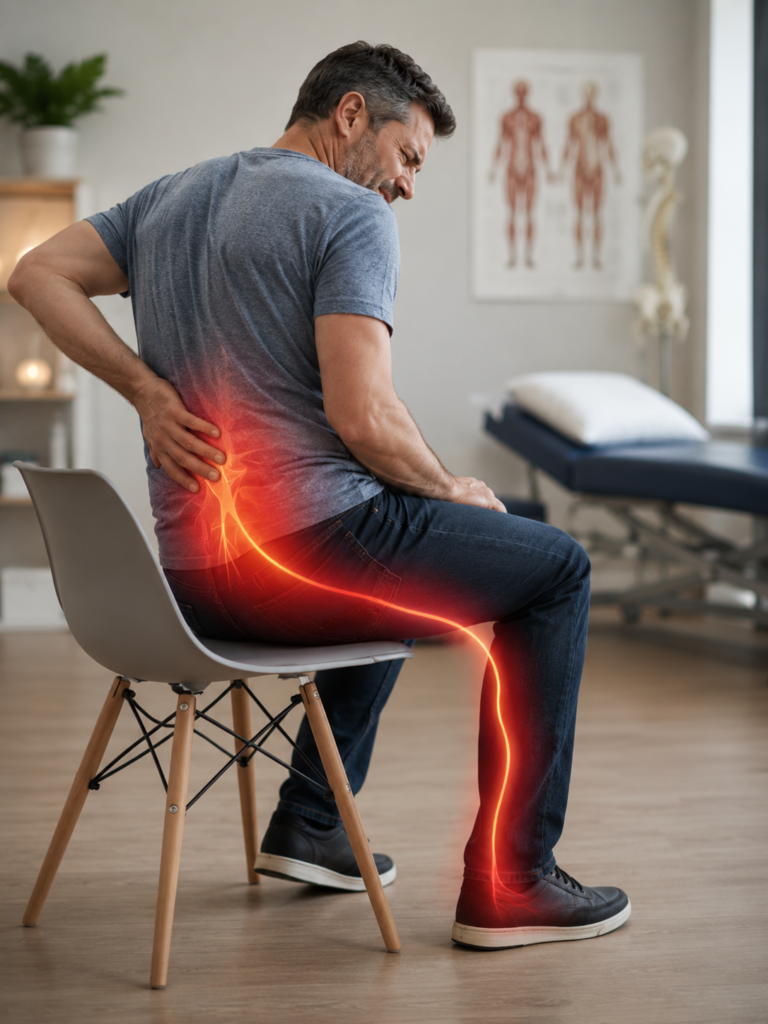
L5-S1 is frequently involved in disc herniation presentations. S1 involvement can cause pain down the back of the leg or sensory and motor changes, but consistency with the clinical findings remains essential.
- Page in this guide series Spinal decompression and sciatica.
- Linked to the main guide Sciatica treatment in Montreal.
- Motorized decompression should not be presented as a guaranteed treatment or as a certain anatomical correction.

Understanding
What spinal decompression can — and cannot — promise
Motorized traction should not be presented as a guaranteed way to put the disc back in place. The clinical goal is instead to assess whether a selected conservative approach improves function and pain.
Not suitable for everyone
The same technique is not suitable for every cause of sciatic pain or radiculopathy.
Measurable goals
Walking, sitting time, sleep, leg pain and function help assess the response.
Reassessment
A lack of progress or neurological deterioration should prompt a review of the strategy.
Clinical selection
Why the likely diagnosis matters before treatment
Follow-up should pay particular attention to strength, toe walking, the Achilles reflex when relevant and the overall clinical course.

An important limitation of the evidence
NICE advises against routine traction for low back pain with or without sciatica. Any use of motorized traction should therefore be presented cautiously, without promising results and with objective reassessment.
Assessment
What can be assessed before and during a trial of treatment
A consultation can document the affected side, the path of the pain, strength, sensation, walking and activities that are limited. Existing imaging is interpreted only when relevant to the clinical presentation.

Likely diagnosis
Check that a lumbar or nerve root condition is plausible and that important alternative diagnoses have been considered.
Security
Check for contraindications, emergency signs and findings that warrant referral.
Goals
Define one or more concrete functional measures to monitor.
Reassessment
Decide whether to continue, modify or stop according to the response rather than a fixed number of sessions.
Role in the care plan
A passive approach should not replace activity and self-management
Guidelines emphasize information, maintaining tolerated activities and appropriate exercise. When motorized traction is tried, it should be part of an overall strategy rather than the sole component of treatment.
Gradual activity
Maintain or rebuild the abilities needed for activities that matter to the patient.
Motorized traction
A passive approach whose suitability and tolerability must be assessed individually.
Medical referral
To be considered according to severity, duration, neurological signs and whether imaging findings match the clinical presentation.
When should routine care stop and a prompt assessment be sought?
- New, significant or rapidly progressive weakness.
- Recent foot drop or a leg that gives way more often.
- New bladder or bowel problems.
- Numbness in the saddle area or perineum.
- Unusual symptoms, fever, significant trauma or a decline in general health.
These signs should not wait for a routine traction or decompression session.
Follow-up
Base the decision to continue on measurable results
Follow-up can compare radicular pain, walking distance, sitting time, sleep, work and the ability to resume activities. Real progress must be distinguished from temporary relief alone.

Radicular pain
Monitor its intensity, how far it extends down the leg and its duration.
Function
Compare activities that were initially limited with the current situation.
Main topic guide
Would you like to know whether a decompression approach is worth discussing in your case?
A consultation can help clarify the likely diagnosis, contraindications, functional goals and other care options.
Spinal decompression in Montreal · Spinal decompression in Terrebonne
Frequently Asked Questions
FAQ — Spinal decompression, L5-S1 herniated disc and sciatica: indications and limitations
Does an L5-S1 herniation always cause S1 sciatica?
No. The imaging level should be consistent with the clinical signs.
Can traction put the disc back in place?
It is not appropriate to guarantee this mechanism or an anatomical result.
Which signs may suggest S1 involvement?
Pain down the back of the leg, certain sensory changes, plantar flexion strength and the reflex can contribute to the assessment.
Can I continue walking?
Tolerable activity is generally encouraged unless safety considerations indicate otherwise.
When is prompt reassessment needed?
If new weakness develops, pain worsens rapidly or function declines.
Is a surgical opinion always necessary?
No. It depends on severity, the clinical course, neurological findings and the response to non-surgical care.
Which signs require emergency care?
New bladder or bowel dysfunction, saddle anaesthesia or significant, rapidly progressive weakness.
Medical references
References and guidelines
These references provide a framework for the general management of sciatica, the use of imaging and the limitations of traction. They do not establish that motorized traction is indicated for a particular patient.
- NICE NG59 — Low back pain and sciatica: assessment and management
- American College of Radiology — Appropriateness Criteria: Low Back Pain
- North American Spine Society — Clinical Guidelines
Important information
This page provides general information and does not establish a diagnosis. Spinal decompression is a nonsurgical traction approach; results cannot be guaranteed, and its suitability must be assessed individually.
Sylvain Desforges, docteur en ostéopathie
TAGMED Clinic — Spinal decompression, specific osteopathy and assessment of low back, disc-related and sciatic pain.
Professional profile · Contact · Main guide to sciatica in Montreal
In the same guide series
Related guides to sciatica
Continue with guides that explore the same symptom, its possible cause, assessment or options for care.
Sciatica treatment in Montreal
TAGMED Clinic Montreal / Mount Royal — Sciatica treatment in Montreal. Free examination, valued at CAD $85. Request your free examination and check availability…

Spinal decompression, L4-L5 herniated disc and sciatica: what should be checked?
TAGMED Clinic Montreal / Mount Royal — Spinal decompression, L4-L5 herniated disc and sciatica: what should be checked? Clinical criteria, safety, limitations of motorized traction and…

Spinal decompression and sciatica: indications, limitations and patient choice
TAGMED Clinic — Montreal / Mount Royal and Terrebonne. Spinal decompression and sciatica: indications, limitations and patient choice. Understanding spinal decompression to prepare for your…

Spinal decompression for sciatica: indications and limitations
TAGMED Clinic Montreal / Mount Royal — Spinal decompression for sciatica: indications and limitations. Clinical pointers, signs to monitor and next steps for pain…

Spinal decompression, foraminal stenosis and sciatica: what can you reasonably expect?
TAGMED Clinic Montreal / Mount Royal — Spinal decompression, foraminal stenosis and sciatica: what can you reasonably expect? Clinical criteria, safety and limitations of motorized traction…
Spinal decompression and sciatica: for which patient profiles can it be discussed?
TAGMED Clinic Montreal / Mount Royal — Spinal decompression and sciatica: for which patient profiles can it be discussed? Clinical criteria, safety and limitations of motorized traction…