TAGMED Clinic | Specialized Osteopathy and Advanced Technologies
What if your knee pain came from an imbalance involving your pelvis and iliotibial band?
Some pain at the front or side of the knee may be influenced by the mechanics of the pelvis, hip and iliotibial band, as well as kneecap alignment.
At Clinique TAGMED, we have been assessing complex musculoskeletal pain that defies simple explanations for more than 35 years. Knee pain is not always solely a local knee problem. In some cases, it may be influenced by a biomechanical chain that starts higher up: the pelvis, hip, control of the lower limb, tension in the iliotibial band and functional kneecap alignment.
This approach must nevertheless remain cautious. The literature does not support the claim that a “misaligned pelvis” alone automatically causes knee pain. The more defensible model is a dynamic imbalance: poor control of the pelvis and hip, hip adduction or internal rotation, increased tension in the lateral chain, lateral pull on the kneecap and, ultimately, patellofemoral overload.
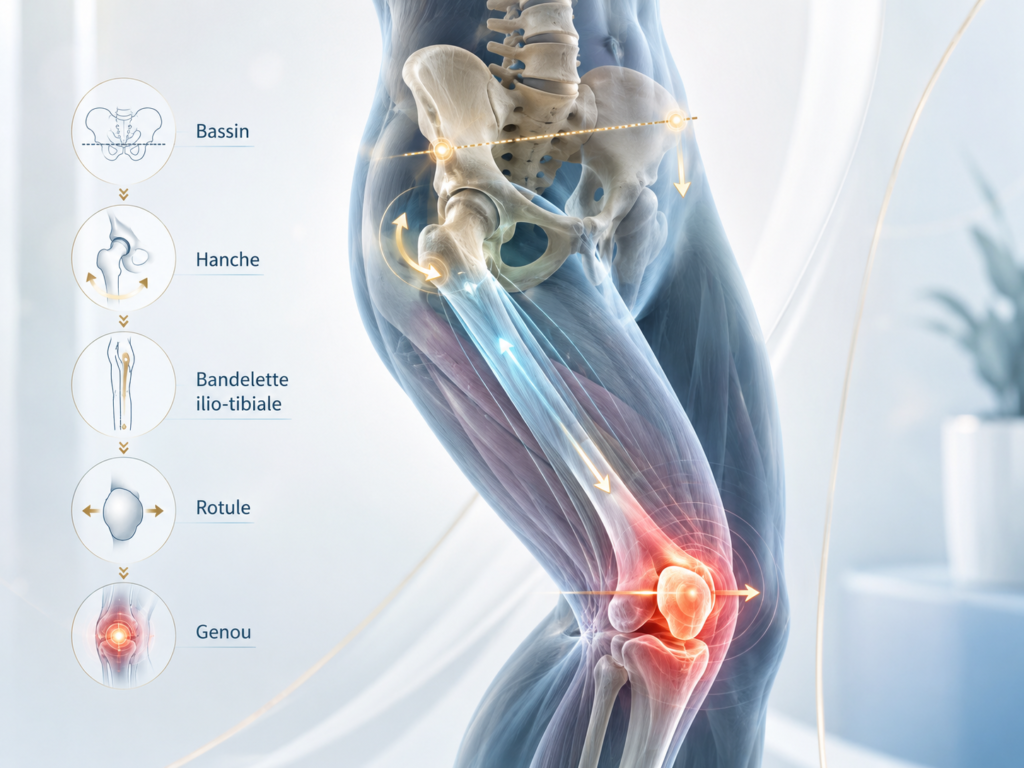
Understanding the underlying problem
Knee pain can sometimes come from compensation higher up
Many patients experience knee pain, particularly at the front, on the outer side or around the kneecap, without understanding why it returns despite rest or local treatment. In many cases, it is necessary to look beyond the knee itself.
The pelvis and hip directly influence lower-limb mechanics. When the pelvis lacks stability, the hip moves into adduction or internal rotation, or the lateral chain becomes dominant, the knee may be subjected to abnormal stresses. The kneecap may then be pulled or compressed further outward, creating lateral patellofemoral overload.
The key point
The problem is not simply that the pelvis is “crooked.” What matters is how the pelvis, hip and knee behave during movement: walking, climbing stairs, running, squatting, standing on one leg or changing direction.
A cautious and responsible approach
First rule out significant medical or structural conditions
The most cautious approach to persistent, unusual or recurring knee pain is to first undergo the necessary examinations recommended by your physician. Depending on your situation, these may include an X-ray, MRI, ultrasound, blood tests or an orthopaedic assessment to rule out a significant meniscal, ligament, cartilage, inflammatory or joint condition.
This step is essential because some knee pain may be associated with a structural condition, kneecap instability, cartilage damage, patellar tendinopathy, a plica, bursitis, a meniscal injury or an inflammatory condition requiring specific medical care.
When examinations do not explain the symptoms
This is precisely where our approach becomes relevant. When medical examinations reveal no condition that clearly explains the pain, it makes sense to examine often-overlooked functional causes: pelvis, hip, iliotibial band, kneecap, motor control and movement patterns.
At Clinique TAGMED, our role is not to replace medical assessment. Our role is to assess whether a biomechanical, postural, muscular or proprioceptive component may be contributing to your symptoms once concerning medical causes have been ruled out.
The pelvis–hip–knee chain
Why the pelvis can influence the kneecap and knee pain
The knee sits between two major control systems: the foot below and the hip and pelvis above. When the pelvis lacks stability or the hip moves poorly, the femur may assume a position that increases stress on the kneecap.
The strongest model is insufficient dynamic control, rather than a pelvis that is statically “displaced.” When standing on one leg, climbing stairs, running or squatting, excessive hip adduction or internal rotation may increase lateral pull on the structures around the knee.
This dynamic may increase the demands placed on the lateral chain, the iliotibial band and the lateral retinaculum. One possible consequence is increased lateral displacement, lateral tilt or lateral compression of the kneecap.
1. Pelvis
Pelvic tilt, rotation or loss of dynamic control may alter hip mechanics.
2. Hip
Hip adduction or internal rotation may increase the stresses transmitted to the knee.
3. Iliotibial band
A dominant lateral chain may influence lateral tension around the kneecap.
4. Kneecap
The kneecap may experience greater lateral displacement, tilt or compression.
Iliotibial band
The role of the iliotibial band in pain at the front or side of the knee
The iliotibial band is a fibrous structure along the outer side of the thigh. It functionally connects the hip to the knee and contributes to lateral stability of the lower limb. It is influenced by tension in the tensor fasciae latae muscle, the gluteal muscles, hip mechanics and overall pelvic control.
When the iliotibial band becomes too tight or too dominant in a compensatory strategy, it may increase lateral tension around the knee. This tension may contribute to lateral stress on the kneecap, particularly when hip and pelvic control are insufficient.
It is important, however, not to oversimplify the mechanism. The iliotibial band does not automatically cause knee pain. It may become a contributing link in a broader chain involving the pelvis, hip, kneecap, foot and motor control.
What is well supported
- Hip mechanics influence the knee
- Hip weakness or poor hip control may contribute to patellofemoral pain
- Iliotibial band tension may influence the lateral position of the kneecap
- Lateral kneecap malalignment is a plausible clinical mechanism
Where caution is needed
- A misaligned pelvis is not automatically the sole cause
- The iliotibial band alone does not explain all knee pain
- A high-riding kneecap is often structural and requires objective confirmation
- Knee pain first requires a thorough assessment
The precision percussion device
Why a precision percussion instrument may be useful for this type of pattern
The precision percussion instrument allows a rapid, targeted, low-amplitude mechanical impulse to be applied to a specific area. For knee pain influenced by the pelvis, hip and lateral chain, it may be used to stimulate areas of restriction or compensation without imposing aggressive movement.
The aim is not to mechanically “put the knee or kneecap back in place” in an oversimplified way. Rather, the aim is to provide precise mechanical input to the nervous system and tissues to gradually modify a pattern of protection, tension or compensation.
Targeted stimulation
The percussion instrument allows work on a specific area of the pelvis, hip or lateral chain.
Low amplitude
The intervention is generally well tolerated, even by patients who are sensitive or in pain.
Neurological approach
The stimulation may help modify the proprioceptive response and compensatory pattern.
Why the order of treatment matters
In some cases, treating the knee directly without addressing compensations in the pelvis or hip may produce an incomplete result. The order of intervention may therefore be important: pelvis, hip, lateral chain, kneecap, followed by reassessment of the knee.
The biomechanical model
The most plausible sequence: pelvis, hip, iliotibial band, kneecap, knee
The most defensible clinical model is a dynamic chain. An imbalance in the pelvis or hip may contribute to increased hip adduction or internal rotation. This position increases the demand for lateral stabilization, encourages dominance of the lateral chain and iliotibial band, and then influences lateral displacement or tilt of the kneecap.
Pelvic control
The pelvis is assessed during movement, not only in a static position. The aim is to understand how it influences the hip and knee during functional movements.
Hip mechanics
A hip that moves into adduction or internal rotation may increase the lateral stress transmitted to the knee.
Lateral chain dominance
The lateral chain may become dominant in a compensatory strategy, particularly when hip control is insufficient.
Iliotibial band
Iliotibial band tension may influence the lateral retinaculum and its functional relationship with the kneecap.
Kneecap malalignment
The kneecap may be pulled or compressed further outward, increasing lateral patellofemoral loading.
Knee pain
The patient may experience pain at the front or side of the knee or around the kneecap, often aggravated by stairs, squats or prolonged walking.
High-riding kneecap or lateral malalignment?
An important distinction to avoid premature conclusions
Many patients describe their kneecap as “out of place.” However, several different situations must be distinguished: a high-riding kneecap, lateral displacement, lateral tilt, lateral compression, instability or simply functional patellofemoral pain.
The literature provides stronger support for a link between lateral iliotibial band tension and lateral kneecap malalignment than for a direct link between tensor fasciae latae tension and a high-riding kneecap. A truly high-riding kneecap often reflects a structural issue with patellar height, which requires objective confirmation using imaging indices such as Insall–Salvati or Caton–Deschamps.
Key takeaways
The iliotibial band may influence the lateral dynamics of the kneecap, but this does not mean that it alone causes a kneecap to sit too high. A high-riding kneecap must be documented through imaging and interpreted within the full clinical context.
Possible signs
Signs that knee pain may involve the pelvis and iliotibial band
Pain around the kneecap
Pain is often felt at the front of the knee, around or behind the kneecap, particularly on stairs, during squats or with prolonged bending.
Pain on the outer side
Tension in the iliotibial band or lateral retinaculum may contribute to pain on the outer side or an outward pulling sensation.
Knee moving inward
During a squat, a step-down or single-leg stance, the knee may move inward, a possible sign of insufficient proximal control.
Pelvic instability
Pelvic drop, rotation or trunk compensation may alter the functional alignment of the lower limb.
Iliotibial band tension
Tenderness or tension along the outer hip or thigh may indicate lateral chain dominance.
Pain that returns despite local treatment
When the knee is treated locally but the pain returns, compensations higher up should be assessed.
TAGMED expertise
More than 35 years of assessing pain that cannot always be explained locally
Clinical experience plays a key role in this type of condition. Knee pain may be associated with a tender kneecap, lateral tension, restricted hip movement, pelvic instability, foot compensation or a movement strategy dominated by the iliotibial band.
The challenge is not only to identify where the patient feels pain. It is to understand why the load is concentrated there. This overall assessment is precisely what distinguishes the TAGMED approach.
Sylvain Desforges, docteur en ostéopathie, draws on more than 35 years of experience in specialized osteopathy, manual medicine and advanced technologies to assess the relationships between the pelvis, hip, iliotibial band, kneecap and knee pain.
Treatment is not standardized. It is adapted to the individual, tissue tolerance, the duration of the problem, previous examinations and the response observed after each intervention.
Our clinical protocol
An assessment in a logical sequence
One distinctive feature of the approach used by Sylvain Desforges, docteur en ostéopathie, is that it addresses more than the painful area alone. Knee pain may be the final expression of an imbalance that starts higher up, in the pelvis or hip.
This procedure does not replace the medical examinations recommended by your physician. It becomes particularly relevant when serious medical or structural conditions have been ruled out and the clinical picture suggests a mechanical, postural or functional neurological component.
Review of the medical context
We take into account previous examinations, medical recommendations and signs that may require a medical referral.
Pelvic assessment
We assess mobility, asymmetry, possible rotation and, above all, how the pelvis behaves during movement.
Hip assessment
Hip stability, adduction, internal rotation and muscular strategy are assessed during functional movements.
Lateral chain assessment
We assess whether the iliotibial band and lateral tissues appear to contribute to the stress felt in the knee.
Kneecap assessment
Mobility, tenderness, lateral tilt and signs of patellofemoral overload are included in the assessment.
Correction with a precision percussion instrument
The percussion instrument is used in a sequence determined by the assessment. The correction is targeted, gentle and progressive.
Immediate reassessment
After each intervention, we reassess mobility, posture, weight-bearing, pain and the response of the knee.
Personalized plan
A care plan may be recommended based on the duration and intensity of symptoms and the initial response.
What we do not promise
A thorough approach does not attribute every case of knee pain to a misaligned pelvis
Knee pain may have several causes: meniscal, ligament or cartilage problems, osteoarthritis, kneecap instability, tendinopathy, bursitis, plica, inflammation, pain referred from the hip or back, or training overload. This is why a thorough assessment is essential.
Before beginning a mechanical or postural approach, you should follow your physician’s advice and complete the appropriate medical examinations to rule out any serious or progressive condition, or one that will not resolve naturally. When these examinations do not identify a medical cause that clearly explains the symptoms, a biomechanical assessment of the pelvis, hip, iliotibial band and kneecap becomes particularly relevant.
Our aim is to identify whether a mechanical, postural or proprioceptive component may be contributing to your symptoms. When this is the case, treatment with a precision percussion instrument, integrated into an approach combining specialized osteopathy and advanced technologies, may be considered as part of an individualized plan.
A realistic explanation
The knee may be where pain is felt, but the trigger may sometimes arise from poor control of the pelvis, hip or lateral chain. If this chain is involved, the care plan must consider overall movement, not only the knee.
FAQ
Frequently Asked Questions
Can a pelvic imbalance really cause knee pain?
It may contribute, particularly when the imbalance alters hip mechanics and increases stress on the kneecap. However, the pelvis should not be considered the sole or automatic cause. Knee pain must be assessed as a whole.
Why is the iliotibial band discussed?
The iliotibial band forms part of the lateral chain of the thigh. When it is too tight or overworked, it may contribute to lateral pull around the knee and influence the functional alignment of the kneecap.
Can the iliotibial band shift the kneecap?
It may influence the lateral dynamics of the kneecap, particularly lateral tilt or displacement. However, it should not be considered the sole cause of a high-riding kneecap or a structural kneecap problem.
What is a high-riding kneecap?
A high-riding kneecap is a structurally higher position of the kneecap relative to the femur. It requires objective confirmation through imaging and specific indices, such as Insall–Salvati or Caton–Deschamps.
Why should the recommended medical examinations be completed first?
Because some knee pain may be related to meniscal, ligament, cartilage, inflammatory or structural conditions. Once these causes have been ruled out, biomechanical assessment becomes more relevant.
Does the precision percussion instrument act directly on the kneecap?
The percussion instrument may be used in specific areas based on the assessment, but the aim is not to force the kneecap into position. The aim is to stimulate areas of restriction or compensation involved in the overall pattern.
How many treatments are needed?
This depends on the duration and severity of symptoms, pelvic and hip mobility, lateral chain tension, previous examinations and the initial response to treatment.
When should you seek medical help quickly?
Significant pain with marked swelling, a locked knee, sudden instability, inability to bear weight, fever, recent trauma or unusual night pain requires prompt assessment by a physician or an emergency service.
Does your knee pain return despite local treatment?
recommended medical examinations When the recommended medical examinations do not clearly explain your symptoms, an assessment at Clinique TAGMED may help determine whether your pelvis, hip, iliotibial band or functional kneecap alignment are contributing to your pain. Our approach combines specialized osteopathy, a precision percussion instrument and an overall biomechanical assessment.
Our clinics
TAGMED Clinic Montreal and Terrebonne
TAGMED Montreal Clinic
1140 avenue Beaumont, Mont-Royal, QC, H3P 3E5
Phone : 1-877-672-9060
Days: Tuesday and Thursday
TAGMED Clinic Terrebonne
1150 rue Levis, suite 200, Terrebonne, QC, J6W 5S6
Phone : 450-704-4447
Hours: Monday and Wednesday, 8 a.m. to 6 p.m.
Important note
Clinique TAGMED is a clinic for specialized osteopathy and advanced technologies. The information on this page is provided for educational purposes and does not replace a medical assessment. If you experience severe, new, progressive or concerning symptoms, consult a physician or an emergency service.
Please note that we do not offer physiotherapy, chiropractic, injections, naturopathy or functional medicine services at the TAGMED Clinic.
Receipts are issued for eligible services depending on the nature of the consultation, particularly in osteopathy, and may be submitted to most private plans according to the terms of your insurance contract. These services are not covered by RAMQ.